An early CYP26A1/CRYAA progenitor-glial domain marks the presumptive macular region during human retinal development

An early CYP26A1/CRYAA progenitor-glial domain marks the presumptive macular region during human retinal development
Yang, Q.; Docampo-Seara, A.; Powner, M. B.; Chung, G. H.; Ribeiro-Bravo, I.; Rody, E.; MacDonald, R. B.; Giles, S.; Polanski, K.; Talavera-Lopez, C.; Eade, K. T.; Teichmann, S. A.; Fruttiger, M.
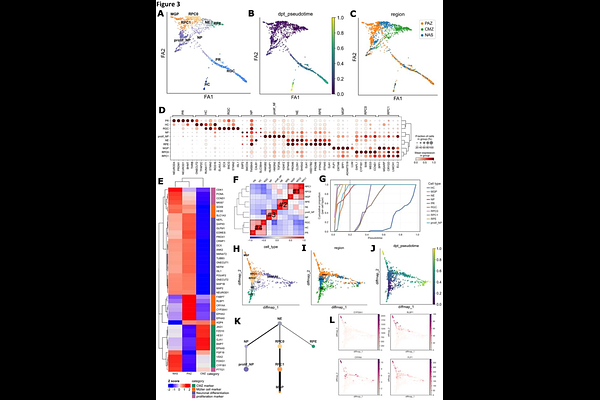
AbstractThe human macula, a high-acuity retinal region essential for central vision, emerges early in development, but the cellular basis of its regional specialisation remains incompletely resolved. Building on recent studies that identified CYP26A1-mediated retinoic acid (RA) suppression in the presumptive macula, we define a CRYAA-positive progenitor-glial compartment in the temporal human retina from post-conception week (pcw) 7 onward. Single-cell RNA sequencing, immunohistochemistry and spatial morphometry indicate that this compartment is linked to regional gliogenic maturation and later corresponds to a specialised macular Müller glial population, rather than simply reflecting uniform pan-retinal developmental timing. Spatial mapping shows that the CYP26A1-positive domain remains delimited as the surrounding retina expands. Adult tissue analysis shows that CYP26A1 expression is retained in primate macular Müller glia and in corresponding acute-zone regions of visual-streak species. These findings extend current models of CYP26A1-mediated RA modulation in human acute zone/macular development by linking the early CYP26A1 domain to a regionally specialised CRYAA-positive progenitor-glial compartment. We propose that early macular patterning includes a spatially restricted glial programme that may contribute to later regional architecture and disease vulnerability.