Vegfc-Vegfr3-Dependent Lymphatic Sprouting Requires Apelin Signaling

Vegfc-Vegfr3-Dependent Lymphatic Sprouting Requires Apelin Signaling
Lehne, F.; Bockelmann, E.; Eryilmaz, E.; Malchow, J.; Weiss, L. W.; Helker, C. S. M.
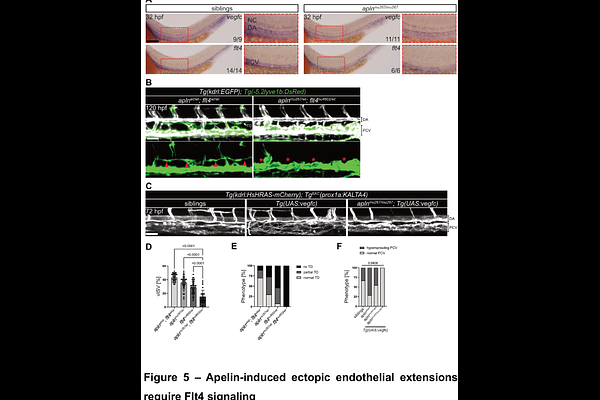
AbstractWhile Vegfc-Vegfr3 signaling is the primary driver of lymphangiogenesis, the role of G protein-coupled receptors (GPCRs), the most successful class of druggable targets in the human genome, remains far less understood. A previous study has implicated Apelin signaling and its receptor Apelin receptor (Aplnr), a class A GPCR, in lymphatic development, yet the underlying cellular and molecular mechanisms remain unclear. Here, we show that Apelin signaling is indispensable for Vegfc-Vegfr3-dependent lymphatic sprouting and promotes lymphatic endothelial cell (LEC) migration without affecting LEC specification. Loss of Apelin signaling resulted in defective sprouting of ECs from the posterior cardinal vein (PCV) and subsequent failure of lymphatic vessel formation. Conversely, Apelin overexpression induces ectopic endothelial extensions from the PCV, an effect that is suppressed by reducing Vegfr3 signaling. Mechanistically, we show that Vegfc signaling through ERK activation regulates Aplnr expression. We propose that the specific upregulation of Aplnrb in LECs renders them migration-competent, establishing Apelin signaling as a critical and non-redundant regulator of lymphatic sprouting. Overall, our results reveal a tightly coordinated signaling axis between growth factor and GPCR pathways that governs lymphatic endothelial behavior.