A canonical four-state macro-architecture governs multimodal fear-goal arbitration across learning and relapse

A canonical four-state macro-architecture governs multimodal fear-goal arbitration across learning and relapse
Yin, B.; Rao, J.; Wang, X. T.
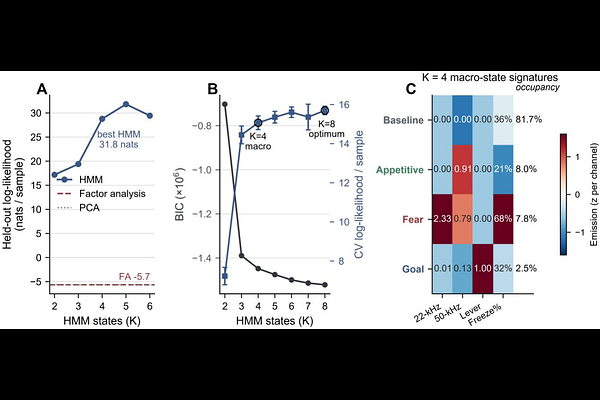
AbstractFear, safety, and goal pursuit are often studied with separate behavioral readouts, leaving open whether multimodal behavior is organized by continuous response intensity or by discrete latent modes. We reconstructed a four-channel, 5-s time-binned rat dataset spanning fear learning, threat generalization, long-delay retest, extinction, retrieval, and renewal. The primary complete-case analysis contained 47,004 four-channel bins from 29 rats and 213 subject-sessions. We compared continuous latent-factor baselines with hidden Markov and semi-Markov sequence models using freezing, 22-kHz ultrasonic vocalizations, 50-kHz ultrasonic vocalizations, and lever pressing. Discrete sequence models strongly outperformed PCA/factor-analysis baselines. Although empirical fit improved up to eight microstates, these states coarse-grained into four biologically interpretable macro-modes: Quiescent/Baseline, Safety/Appetitive, Danger/Fear, and Goal-directed behavior. The four-state macro-model captured 96% of the optimal cross-validated likelihood and was highly stable across random initializations and leave-one-subject-out validation. Across conditioning, extinction, and renewal, emission signatures remained comparatively stable while transition matrices reconfigured strongly. Session-level fecal boli were predicted by decoded state occupancy better than mean freezing alone. These findings support a canonical discrete macro-architecture for fear-goal arbitration, with learning and relapse expressed primarily as context-dependent transition reweighting.