Optimal control with flag qubits

Optimal control with flag qubits
Liang-Xu Xie, Lui Zuccherelli de Paula, Weizhou Cai, Qing-Xuan Jie, Luyan Sun, Chang-Ling Zou, Guang-Can Guo, Zi-Jie Chen, Xu-Bo Zou
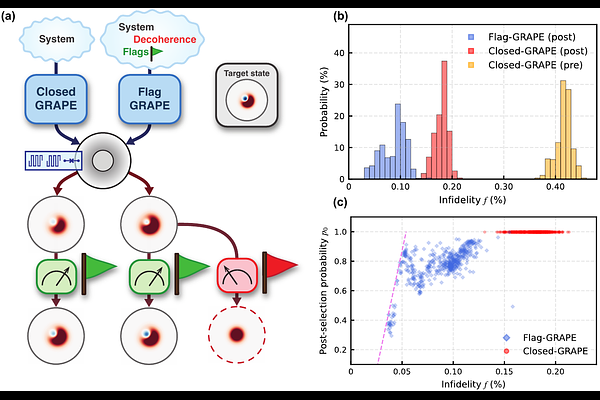
AbstractHigh-fidelity quantum operations are the cornerstone of fault-tolerant quantum computation. In open quantum systems, traditional optimal control only passively resists decoherence, leaving environment-induced uncertainty as a fundamental performance bottleneck. To overcome this, we propose a new optimal control framework with flag ancillas and the Flag-GRAPE algorithm, which can actively tailor the system's noise structure. Through embedding post-selection directly into the objective function, Flag-GRAPE correlates decoherence errors with the ancilla's unexpected state. Subsequent measurement and post-selection effectively expel this uncertainty, circumventing the fidelity bounds of traditional control. Numerical simulations in a superconducting quantum circuit demonstrate a $51\%$ reduction in infidelity compared to traditional closed-system pulses and also show that such enhancement is robust across broad noise regimes. Furthermore, by actively converting unstructured decoherence into heralded erasure errors, Flag-GRAPE is inherently compatible with quantum error correction. We demonstrate this by initializing a logical cat-code state, showing that the combination between Flag-GRAPE and QEC yields immediate state preparation enhancements. This new framework can reduce hardware overhead for fault-tolerant architectures and open up a practical path toward logical state preparation gain in near-term experiments.