Gene conversion is a key driver of diversity hotspots in M. tuberculosis antigens and virulence-associated loci

Gene conversion is a key driver of diversity hotspots in M. tuberculosis antigens and virulence-associated loci
Marin, M. G.; Quinones-Olvera, N.; Jin, H.; Harris, M. A.; Jeffrey, B. M.; Rosenthal, A.; Murphy, K. C.; Sassetti, C.; Li, H.; Farhat, M. R.
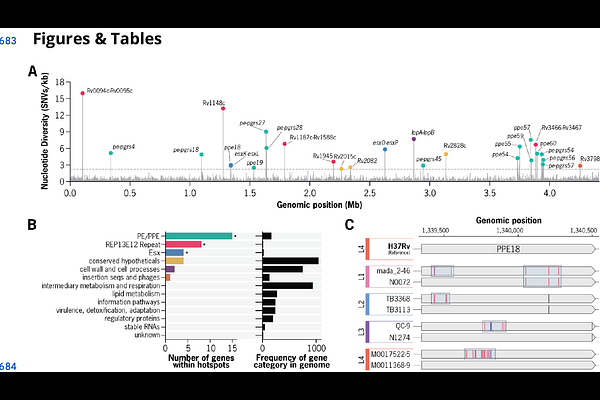
AbstractDespite the long-held view of Mycobacterium tuberculosis (Mtb) as a genetically conserved pathogen, many genomic regions remain poorly resolved due to high sequence homology and repetitive content. Using long- and short-read hybrid assemblies from 151 globally representative clinical isolates, we uncover extensive genetic diversity concentrated within specific paralogous regions. Mutations in these regions display clustered substitution patterns, excess paralog-matching variants, and distinct mutational spectra indicative of ongoing gene conversion. We identify over 300 individual gene conversion events, primarily among specific paralogs in the PE/PPE and ESX gene families associated with virulence and host adaptation. Notably, many of the strongest diversity hotspots occur in antigens encoded within paralogous regions. Among these, the vaccine candidate PPE18 harbors mutations in validated epitope sequences and predicted alterations in HLA-II binding. Together, these findings demonstrate that gene conversion actively shapes antigenic and virulence-associated diversity in Mtb.