Transcriptional regulation by Tbx2 paralogs creates diversity within photoreceptor subtypes

Transcriptional regulation by Tbx2 paralogs creates diversity within photoreceptor subtypes
Householder, C. M.; Lee, A. S.; Apgar, S.; Rinaldi, A. K.; Angueyra, J.
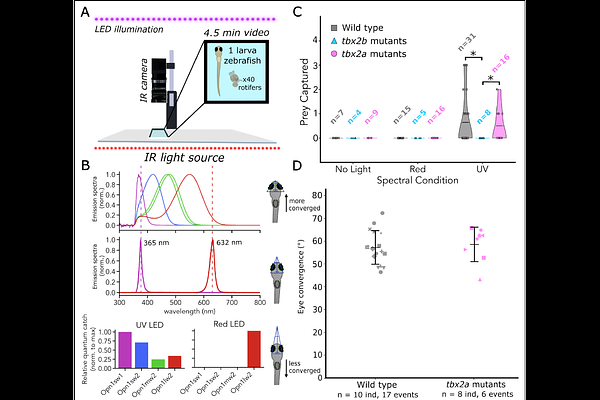
AbstractPhotoreceptors are retinal neurons whose subtype-specific opsin expression and mosaic organization enable parallel encoding of spectral and spatial visual information. Yet, the transcriptional mechanisms establishing and maintaining subtype identity remain poorly understood. We investigated the role of the T-box transcription factors tbx2a and tbx2b in zebrafish photoreceptor development and found evidence for paralog subfunctionalization across photoreceptor lineages. Tbx2b is required for UV-cone generation and prevents fate switching toward rods, while Tbx2a is constrained to UV-cone generation without involving rods. These factors also maintain cone identity by repressing inappropriate M-cone fate. Despite major changes in photoreceptor composition, tbx2 mutants retain luminance- and motion-driven vision, whereas prey capture is abolished only in tbx2b mutants and not tbx2a mutants. Our findings identify the tbx2 paralogs as key regulators of cone-subtype generation and maintenance and reveal how developmental programs diversify photoreceptor fate to appropriately support visually-guided behaviors important for survival.