Hyperbolic Chiral Numerical Schemes for General Relativity

Hyperbolic Chiral Numerical Schemes for General Relativity
Adam Shaw
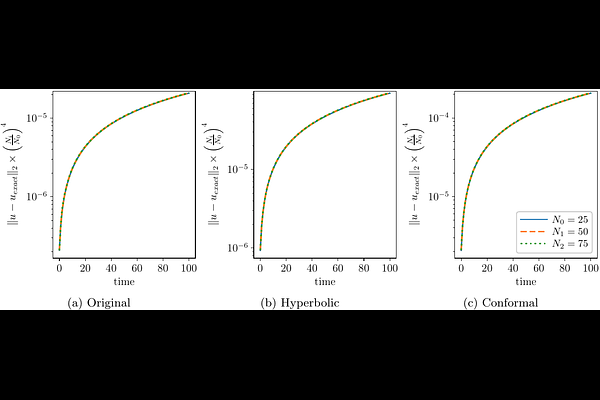
AbstractWe develop numerical relativity evolution schemes based on Plebanski's chiral formulation of general relativity and its 3+1 form, Ashtekar's variables. At the linear level, we construct a two-parameter family of first-order gauge fixings that dynamically fixes both diffeomorphisms and internal SO(3,C) rotations; after a linear field redefinition, the resulting system splits into independent 12- and 4-component sectors. Lifting this gauge fixing to its minimal nonlinear extension and performing the 3+1 decomposition yields a strongly hyperbolic modification of Ashtekar's evolution equations that remains polynomial in the fields and includes constraint damping. We also introduce a conformal (unimodular) reformulation in which the nonlinear 12-component sector evolves completely independently of the remaining fields. All three systems are tested with gauge-wave convergence tests, robust-stability tests on a noisy Minkowski background, and long-time evolutions. The unmodified Ashtekar system crashes at T ~ 325, whereas the gauge-fixed hyperbolic and conformal systems remain stable up to T = 2000, with constraint violations and the imaginary part of the metric remaining at the 10^{-10} level.