Deep Learning-Assisted Evaluation of Laryngeal Mobility in a Rat Model

Deep Learning-Assisted Evaluation of Laryngeal Mobility in a Rat Model
Mirzaaghasi, A.; Smith, E. M.; Kita, A.
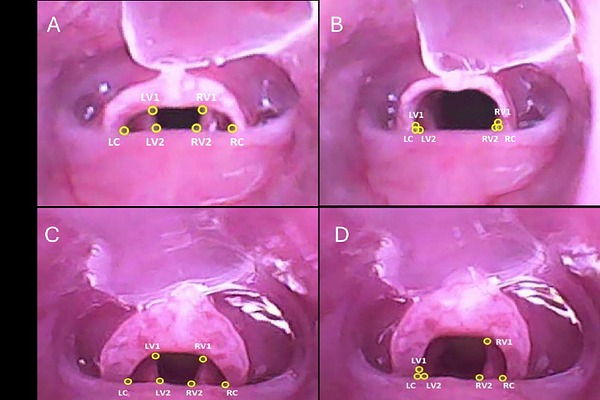
AbstractVocal fold mobility is essential for normal laryngeal function and is often compromised following recurrent laryngeal nerve (RLN) or superior laryngeal nerve injuries. In a rat model of unilateral (RLN) injury, we quantitatively evaluate laryngeal mobility using advanced computer vision techniques. Adult male Long-Evans rats underwent direct laryngoscopy before and after RLN injury at the level of the 5th tracheal ring. High-resolution video recordings were analyzed with the open-source deep learning framework Social LEAP Estimates Animal Poses (SLEAP) to track key laryngeal landmarks. The displacement of the left and right arytenoid processes relative to the anatomical midpoint was measured frame-by-frame. Mean differences and 95% CI were computed for each arytenoid. A mean difference threshold of 0.42 differentiated laryngeal asymmetry from symmetry. This method offers a quantitative method of assessing laryngeal symmetry in a rat model.