Greater benefits of assisted gene flow in F2 vs F1 progeny at the cold edge of a species' range

Greater benefits of assisted gene flow in F2 vs F1 progeny at the cold edge of a species' range
Hendrickson, B. T.; Demarche, M. L.; Maraglia, D.; Gonzalez, O.; Rice, K. J.; Strauss, S. Y.; Sexton, J. P.
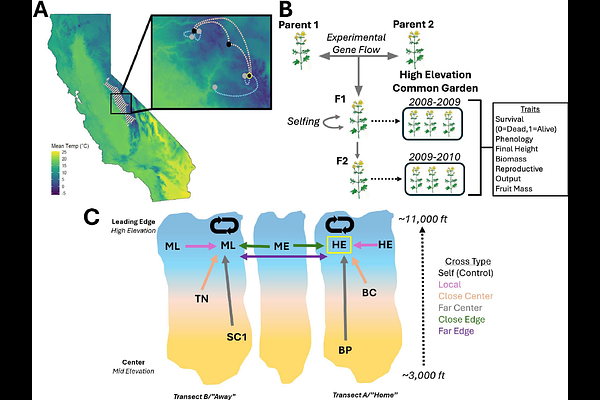
AbstractGene flow to marginal populations at a species' range edge can facilitate rapid adaptation by increasing genetic diversity, reducing inbreeding depression, and introducing novel alleles. In highly inbred populations, hybrid vigor is often observed in the first generation (F1), but hybrid breakdown may diminish fitness in subsequent generations. Thus, benefits of gene flow may be overestimated when only F1 performance is assessed. We tested whether gene flow among populations of the annual plant Erythranthe laciniata (A. Gray) G.L. Nesom, from similar and contrasting environments, confers persistent fitness advantages across F1 and F2 generations at the high-elevation edge of its range in the California Sierra Nevada. Gene flow was experimentally introduced through pollen transfer between cold-edge populations, between cold edge and central populations, and within local cold edge populations, and compared to self-fertilized offspring, the predominant mating strategy of E. laciniata. For F1 progeny, we measured morphological, phenological, and fitness traits in a common garden located near the cold-climate range limit during 2008-2009, a relatively average year, and for F2 progeny in 2009-2010, a relatively wet year. Although F1 crosses showed no initial performance advantage measured in the previous year, F2 progeny from center-to-edge and edge-to-edge crosses significantly outperformed selfed and locally outcrossed lines in fruit mass, total pedicels, biomass, and height. Our findings demonstrate that gene flow can confer long-term fitness benefits, especially among populations adapted to similar selective pressures, and highlight the potential of assisted gene flow to bolster or rescue peripheral populations facing climate change.