Development of a Flex-Seq SNP panel for raspberry (Rubus idaeus L.) and validation through linkage map construction and identification of QTL for several traits of agronomic importance to raspberry breeding

Development of a Flex-Seq SNP panel for raspberry (Rubus idaeus L.) and validation through linkage map construction and identification of QTL for several traits of agronomic importance to raspberry breeding
Davik, J.; Zucchi, P.; Buti, M.; Milne, L.; Graham, J.; Sargent, D.
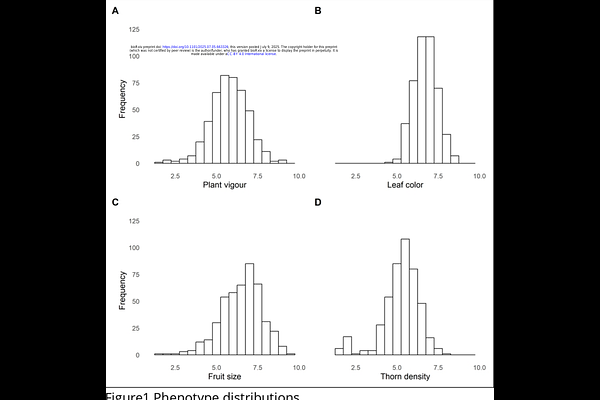
AbstractHigh-throughput and reproducible genotyping platforms are critical for advancing genetic research and breeding in horticultural crops. Here, the development and validation of a custom single nucleotide polymorphism (SNP) panel using the Flex-Seq genotyping platform for red raspberry (Rubus idaeus L.) is described. SNPs were derived from existing linkage maps and RNA-seq data, resulting in a panel of 5,639 high-confidence, bi-allelic markers distributed across the seven chromosomes of the R. idaeus Malling Jewel reference genome. The panel was used to genotype 459 red raspberry accessions including 161 individuals from a bi-parental mapping population (Parisx486), enabling the construction of high-density linkage maps and the identification of quantitative trait loci (QTL) for fruit size, leaf colour, plant vigour, and thorn density. Genome-wide association studies (GWAS) identified a major QTL for thornlessness on chromosome 4, co-locating with a candidate HOX3 gene, and multiple QTLs associated with anthocyanin biosynthesis genes for leaf colour. The SNP panel demonstrated utility for linkage mapping and trait association analyses, offering a powerful resource for marker-assisted selection and genetic improvement in red raspberry.