O3LS: Optimizing Lattice Surgery via Automatic Layout Searching and Loose Scheduling

O3LS: Optimizing Lattice Surgery via Automatic Layout Searching and Loose Scheduling
Chenghong Zhu, Xian Wu, Jiahan Chen, Keming He, Junjie Wu, Xin Wang, Lingling Lao
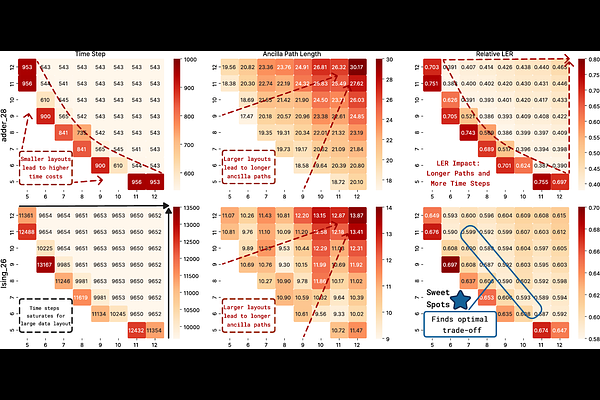
AbstractToward the large-scale, practical realization of quantum computing, quantum error correction is essential. Among various quantum error-correcting codes, the surface code stands out as a leading candidate, and lattice surgery based on surface codes has emerged as a promising technique for fault-tolerant quantum computation (FTQC). However, implementing quantum algorithms using lattice surgery introduces both resource and time overhead. Existing approaches typically focus on large layout designs, with compiler passes aimed primarily at optimizing time overhead. This often overlooks the trade-off between rotation bottlenecks and movement distance, which leads to inefficient resource utilization and prevents further reduction of the quantum computation failure rate. To address these challenges, we introduce O3LS, a framework for optimizing lattice surgery through automatic layout search and loose scheduling. O3LS achieves an optimal balance by automatically generating squeezed data layouts to reduce space requirements and employing loose scheduling algorithms combined with circuit synthesis techniques to reduce time overhead, thereby effectively minimizing overall logical error rates. Numerical results indicate that O3LS can reduce space overhead by 28.0% over standard layouts and 46.7% over sparse layouts without increasing the number of time steps, leading to suppression of logical error rates by up to 16% relative to larger data layout designs. O3LS can also achieve time overhead reductions of 36.07% and 24.76% in compact and standard data layout designs, respectively. It suppresses logical error rates by up to an order of magnitude compared to prior compilers that focus primarily on maximizing parallelism.