Theca cell mechanosensing and regulation of follicular extracellular matrix during ovarian follicle development

Theca cell mechanosensing and regulation of follicular extracellular matrix during ovarian follicle development
Ng, B. H.; Biswas, A.; Tomida, K.; Leong, K. W.; Lou, Y.; Lee, C. H.; Lanting, R.; Lu, T. B.; Hengst, R. M.; Nai, M. H.; Bonne, I.; Young, J. L.; Lim, C. T.; Chan, C. J.
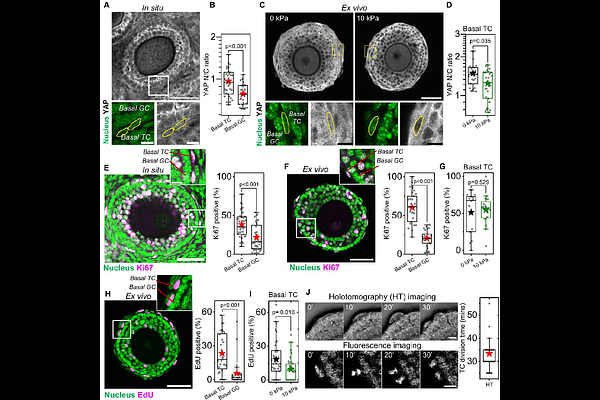
AbstractMammalian folliculogenesis is essential for female hormonal regulation and successful reproduction. While the steroidogenic functions of theca cells (TCs) have been implicated in ovarian diseases and infertility, the physico-structural properties of TCs and their associated extracellular matrix (ECM), or theca matrix, remain poorly understood. Using murine ovaries, we show that a stiff basement membrane (BM) and theca matrix constitute a mechanically instructive niche that modulates TC proliferation and Yes-associated protein (YAP) signalling in secondary follicles. We identify hyaluronic acid (HA) as a key matrix component that is actively secreted by contractile TCs. The HA scaffold, in turn, regulates TC proliferation, YAP signalling and motility, and is required for overall follicle growth. We showed that stiffer substrates enhance YAP nuclear transport in TCs, while mechanical stretch, cell packing, and curvature affect TC proliferation. In addition, TCs exhibit directed migration towards regions of positive curvature. Together, this study reveals a mechanochemical feedback mechanism that establishes TC mechanics and HA as key regulators of theca matrix formation that is essential for mammalian folliculogenesis.