A Chairside Multimodal Platform for Temporomandibular Joint Biomechanical Assessment: Technical Evaluation and Illustrative Application

A Chairside Multimodal Platform for Temporomandibular Joint Biomechanical Assessment: Technical Evaluation and Illustrative Application
Sun, S.; Damon, B.; Zhao, J.; Almpani, K.; Chung, R.; Jani, P.; Mei, J.; Mehrotra, I.; Hill, C.; Ahmadi, F.; Chen, J.; Chen, P.; Slate, E.; Lee, J.; Yao, H.
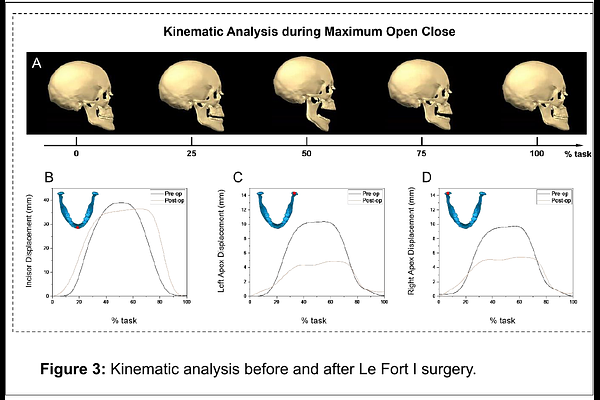
AbstractBackground: Temporomandibular joint (TMJ) biomechanics can be characterized by mandibular motion, masticatory muscle activity, and bite force generation. When acquired synchronously, these functional variables can serve as model-ready inputs for subject-specific computational analyses of internal joint mechanics. However, existing tools typically measure these signals using separate hardware and software platforms, limiting synchronized acquisition within a clinically practical chairside workflow. Methods: We developed and technically evaluated a compact multimodal platform for chairside acquisition of TMJ functional data and demonstrated its analytical utility in an illustrative orthognathic surgery application. The platform integrates motion, bite force, muscle activity, acoustic, and event-timing measurements with software for real-time preview, protocol guidance, and synchronized export. We assessed technical performance and chairside feasibility and analyzed representative pre- and postoperative data from an orthognathic surgery patient using kinematic, force-control, and computational modeling workflows. Findings: Motion capture demonstrated submillimeter accuracy, with static and dynamic errors of approximately 0.04 mm and 0.12 mm. Bite force sensors showed excellent linearity (R2 = 0.998). Chairside deployment required approximately 15 minutes each for setup and data collection. The illustrative case demonstrated that synchronized chairside data can support preoperative and postoperative kinematic analysis, bite force control capacity assessment, and estimation of TMJ disc stress. Interpretation: The proposed platform enables time-efficient chairside acquisition of synchronized, model-ready multimodal datasets for quantitative TMJ biomechanical assessment. This platform and workflow could support subject-specific biomechanical analysis and future clinical studies of temporomandibular joint function.