Quantum transitions of vector vortex light in gravitational waves

Quantum transitions of vector vortex light in gravitational waves
Haorong Wu, Xilong Fan
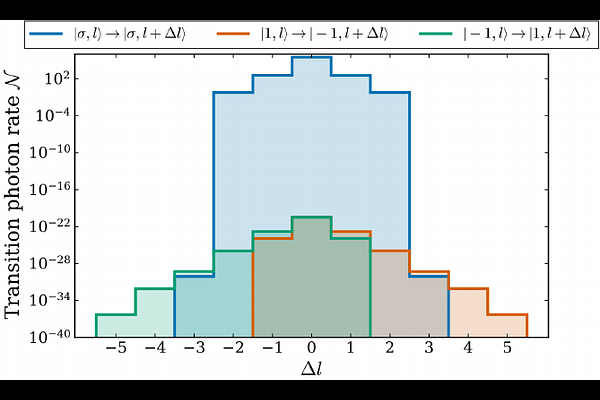
AbstractWe develop a theoretical framework to describe the full interaction between vector vortex light fields and gravitational waves (GWs). Using perturbation theory and the canonical quantization of the electromagnetic field, we calculate the quantum transition probabilities of vector Bessel beams propagating through GWs. We demonstrate that GWs induce fourteen different quantum transition channels across orbital angular momentum (OAM) $l$ and spin angular momentum (SAM) $σ$, mapping initial states $\ket{σ,l}$ to $\ket{σ+Δσ,l+j-Δσ}$, where $Δσ\in \{-2, 0, 2\}$ represents the change in SAM and $j \in \{-3, \dots, 3\}$ denotes the change in total angular momentum. Among these channels, SAM-conserving transitions between OAM states, specifically $\ket{σ, l}\rightarrow \ket{σ, l\pm 1}$, provide the most viable mechanism for experimental detection. Conversely, spin-flip transitions are shown to be heavily suppressed relative to OAM transitions. Additionally, the reversal of SAM induces an asymmetric shift in the OAM transition channels, reflecting the underlying coupling between SAM and OAM during the gravitational interaction. Based on these transition channels, we propose a new cavity-based GW detection configuration. By relying on quantum transitions rather than macroscopic arm-length changes, this scheme is inherently insensitive to displacement-based disturbances like seismic noise, offering a new paradigm and frequency bands for GW observation.