From lab to ocean: bridging swimming energetics and wild movements to understand red drum (Sciaenops ocellatus) behavior in a tidal estuary

From lab to ocean: bridging swimming energetics and wild movements to understand red drum (Sciaenops ocellatus) behavior in a tidal estuary
Gibbs, B.; Strother, J.; Morgan, C.; Pinton, D.; Canestrelli, A.; Liao, J. C.
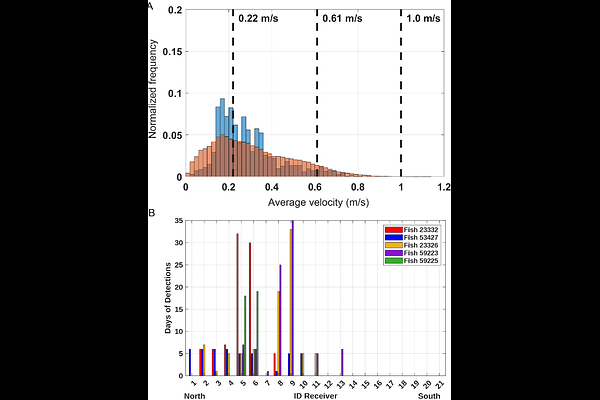
AbstractUnderstanding how fish navigate complex natural environments requires bridging fine-scale biomechanics with ecological behavior. We investigated the volitional movement and energetics of wild red drum (Sciaenops ocellatus) across laboratory, mesocosm, and field settings. Using flow-respirometry, we quantified metabolic costs and swimming kinematics under ecologically relevant flow conditions shaped by bluff bodies mimicking mangrove roots and oyster mounds. Fish swimming in turbulent wakes exhibited reduced oxygen consumption and altered tailbeat dynamics, especially at high flow speeds. In a large outdoor mesocosm, dual accelerometers revealed a rich behavioral repertoire, including maneuvering and rest, which is not easily observable in confined lab settings. Spectral analysis and clustering identified eight distinct locomotory states, highlighting the limitations of summed acceleration metrics. Field telemetry tracked wild red drum across a 54 km estuarine corridor for a three-year period through an array of 36 acoustic receivers, revealing movement patterns shaped by tidal flow and physical habitats. Hydrodynamic modeling revealed that while laboratory trials demonstrated substantial energetic savings at high flows (approaching 100 cm/s), wild fish were detected predominantly in low-velocity microhabitats (<30 cm/s) near structurally complex features. This mismatch suggests that habitat selection is an adaptive strategy driven by ecological factors such as foraging opportunities, predation refuge, and site fidelity, rather than hydrodynamic efficiency alone. Our multi-scalar approach demonstrates that while flow-structure interactions can reduce locomotor costs for fish, habitat use in the wild reflects broader ecological constraints, offering a framework for integrating biomechanics, physiology, and ecology in conservation-relevant contexts.