Drought-tolerant phenotypes associated with patterns of deterministic microbiome assembly across peanut genotypes

Drought-tolerant phenotypes associated with patterns of deterministic microbiome assembly across peanut genotypes
Little, Z. J.; Shantharaj, D.; Chen, C.; Potnis, N.
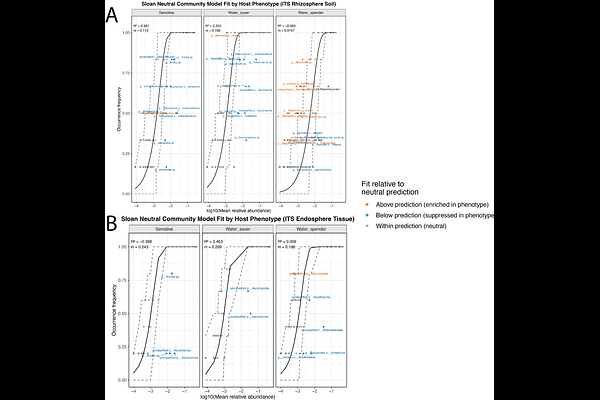
AbstractPlant-associated microbiomes contribute to plant health and resilience, yet the extent to which host traits shape microbiome assembly remains poorly understood despite increasing interest in leveraging them for crop performance. Here, we investigated whether drought-response phenotypes are associated with reproducible patterns of microbiome assembly across peanut genotypes under field conditions. The cultivars represented three drought-response categories: water-savers with tighter stomatal regulation, water-spenders with deeper root systems, and drought-sensitive genotypes. Bacterial and fungal communities were characterized from bulk soil, rhizosphere, and root endosphere compartments of six non-stressed peanut cultivars. Both host genotype and drought-response phenotype were associated with microbiome composition, with phenotype-associated patterns remaining detectable across multiple genetic backgrounds. Unexpectedly, the strongest phenotype-associated differences occurred in bulk soil communities, suggesting plant-mediated effects extending beyond the immediate root zone. Community differences were driven primarily by shifts in the relative abundance of existing taxa rather than turnover of distinct microbial lineages. Fungal communities responded more strongly to host phenotype than bacterial communities, with water-spender genotypes supporting greater fungal diversity and uniquely enriched taxa in the rhizosphere and endosphere. Neutral community modeling indicated stronger deterministic filtering of fungi than bacteria. Together, these findings demonstrate that drought-response phenotypes shape reproducible microbiome variation before stress exposure.