Tunable Laminar Perfusion Coordinates Endothelial and Perivascular Remodeling in Angiogenic Vasculature-on-Chip

Tunable Laminar Perfusion Coordinates Endothelial and Perivascular Remodeling in Angiogenic Vasculature-on-Chip
Nawara, T. J.; Meier, K.; Kuom, J.; Hollfinger, I.; Kraxner, J.; Koch, K. S.; Hastermann, M.; Jablonicka, L.; Vinet Barancourt, L.; Schwarzkopf, J. B.; Gerhardt, H.
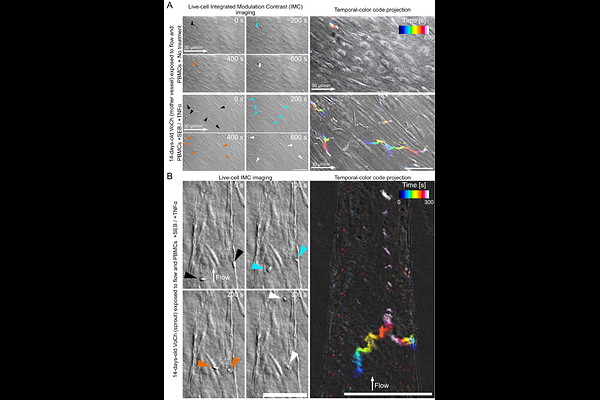
AbstractPerfusable vascular microphysiological systems are increasingly used to model angiogenesis, tissue crosstalk, and disease. However, many platforms still rely on oscillatory, discontinuous, or poorly controlled perfusion regimes, limiting the study of sustained flow-dependent vascular remodeling. Here, we establish a tunable, unidirectional laminar flow workflow for long-term perfusion of angiogenic vasculature-on-chip cultures and use it to investigate endothelial, perivascular, and immune cell responses to sustained flow. Using an AIM Biotech microfluidic platform containing 14-day-old human umbilical vein endothelial cell-derived angiogenic sprouts and pericytes, continuous perfusion enabled intraluminal transport of 1 m tracer beads through vessels, demonstrating stable flow across the vascular bed. Sustained laminar flow induced endothelial remodeling at both the mother vessel and sprout levels, with cellular alignment evident in both compartments. Quantitative analysis of the mother vessel further revealed Golgi polarization against the direction of flow. Sustained perfusion also increased pericyte recruitment to angiogenic sprouts and reduced endothelial proliferation within the mother vessel, consistent with flow-driven vascular maturation and quiescence. Live-cell imaging further captured directional endothelial migration against the flow, lumen remodeling, and dynamic pericyte behavior under continuous perfusion. In immune-cell assays performed under continuous-flow conditions, interactions with untreated endothelium were limited, whereas inflammatory activation increased immune-cell adhesion and crawling. These observations suggest that sustained flow supports a quiescent endothelial phenotype and demonstrate the suitability of the platform for studying inflammatory activation and immune-vascular communication under controlled hemodynamic conditions. Beyond its biological relevance, the workflow provides practical advantages for live-cell imaging, low medium consumption, and downstream perturbation studies. Moreover, the modular design of the platform makes it well suited for vascular-organ crosstalk applications. Collectively, these results establish laminar flow angiogenic vasculature-on-chip as an experimentally tractable model for studying vascular mechanobiology, vascular maturation, and dynamic cell interactions under defined hemodynamic conditions.