Distinct nigral and brainstem pathology markers map onto separable subthalamic electrophysiological signatures in Parkinson's disease

Distinct nigral and brainstem pathology markers map onto separable subthalamic electrophysiological signatures in Parkinson's disease
Delgado-Sanchez, A.; Andrews, L.; Hayton, P. J.; Craig, C.; Macerollo, A.; Cortes-Gutierrez, J.; Martin, S.; Somervail, R.; Azimi, A.; Muller, M. L.; Parkes, L.; Haroon, H.; Bergamino, M.; Kotz, S. A.; Silverdale, M.; Trujillo-Barreto, N.; Ray, N.
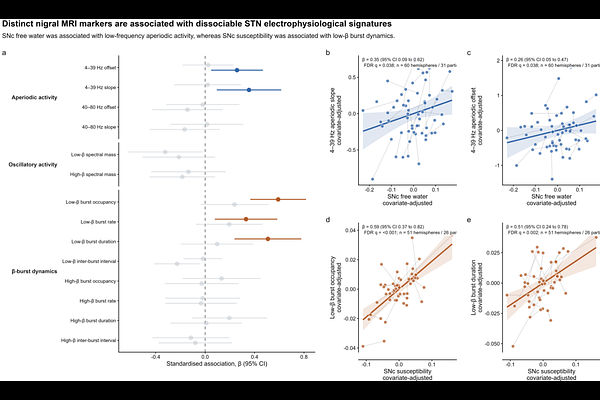
AbstractSubthalamic local field potentials (LFPs) are increasingly used as physiomarkers of the symptomatic state in Parkinson's disease, but their relationship to the underlying neurodegenerative pathology remains unclear. Here, we combined OFF-medication subthalamic LFP recordings with quantitative MRI markers of nigral and brainstem pathology in 33 people with Parkinson's disease. Distinct pathological markers mapped onto dissociable electrophysiological components. Substantia nigra pars compacta susceptibility was associated with increased occupancy, duration and rate of low {beta}; bursts, whereas nigral free water was associated with greater low-frequency aperiodic offset and a steeper slope. Pedunculopontine nucleus free-water-corrected axial diffusivity was selectively associated with high-frequency aperiodic activity, and this relationship strengthened with increasing nigral susceptibility, consistent with dopaminergic-state-dependent influences of extranigral pathology on subthalamic physiology. Only low-frequency aperiodic offset was also associated with contralateral bradykinesia. These findings indicate that the subthalamic LFP is not a unitary readout of dopamine loss or motor state, but an integrated physiological signal in which pathology across interconnected systems is expressed through separable oscillatory and aperiodic components. Chronically implanted devices may therefore provide physiological readouts of underlying disease biology alongside control signals for adaptive therapy.