Functional characterization of bat limb regulatory elements

Functional characterization of bat limb regulatory elements
Ushiki, A.; Kelman, G.; Sheng, R.; Murray, E.; Eckalbar, W.; Zhang, Y.; Nobuhara, M.; Rajani, R.; Friess, K.; Barskyi, V.; Ngo, K.; Kinoshita, S.; Schlebusch, S. A.; Mason, M.; Zhan, S.; Liang, M.; Fong, S.; Haider, M. Y.; Singhal, V.; Schountz, T.; Hockman, D.; Illing, N.; Kaplan, T.; Ahituv, N.
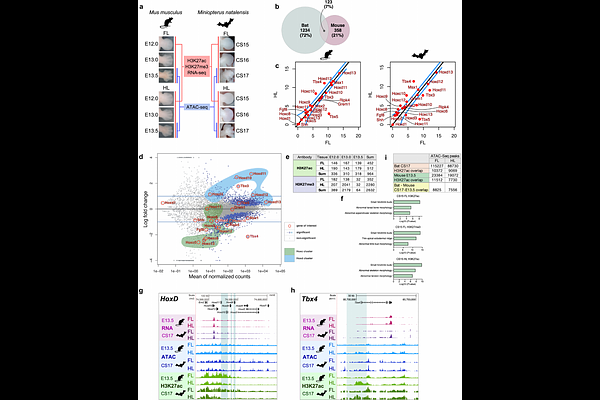
AbstractBats are the only mammals capable of powered flight and roost head-down. However, the molecular changes shaping bat limbs remain largely unknown. Here, we used comparative functional genomics coupled with mouse-bat sequence swaps to identify key regulatory elements important in bat limb development. We generated and compared bat and mouse forelimb and hindlimb genomic datasets at key wing developmental timepoints, followed by mouse enhancer assays to characterize sequences showing differences between species. We then swapped six mouse enhancer sequences with their corresponding bat sequences, obtaining a variety of bat limb associated phenotypes, including ossification delay, longer digits, thicker skin and symmetrical hindlimb digits. Our work provides a genomic catalog of genes and regulatory elements involved in bat limb development and through extensive characterization in mice shows how changes in regulatory elements lead to small phenotypic changes that together contribute to bat limb development.