Age-associated changes to mouse oocyte meiotic spindle properties revealed through in situ measurements

Age-associated changes to mouse oocyte meiotic spindle properties revealed through in situ measurements
Begley, M. A.; Minsky, M.; Schindler, K.
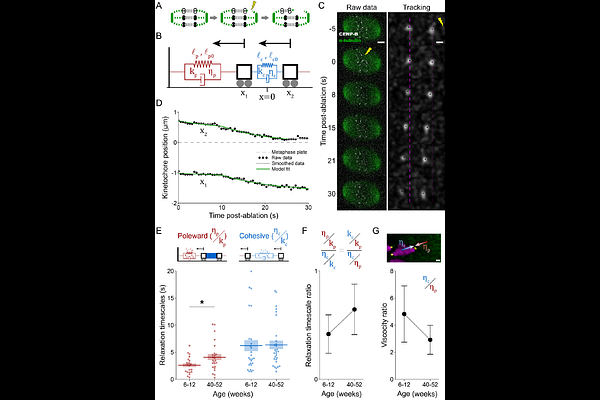
AbstractChromosome segregation errors in oocyte meiosis are a leading cause of early miscarriage and congenital disorders in mammals and these errors become more prevalent with advanced maternal age. Although the effects of aging on the functions of critical meiotic proteins and cytoskeletal filaments in oocytes are known, the influence of aging on the force generating capabilities of oocyte spindle components remains largely unexplored. Through the integration of a coarse-grained model and in situ experiments, we compare the long-axis mechanical properties of metaphase I (MI) and II (MII) oocyte spindles from reproductively young and old mice. Increased inter-kinetochore distance in aged MII oocytes agree with a model of age-associated cohesion loss, and kinetochore dynamics in these spindles following laser ablation suggest a similar reduction in inter-kinetochore bridge viscosity. Simultaneously, we find that both cohesive and poleward force generators lose stiffness with advanced age in MI spindles. In total, we quantify the extent to which structural spindle components lose their stiffness and viscosity during maternal aging, highlighting the multifaceted impacts of aging on mouse oocyte spindle mechanics. Significance StatementO_LIMaternal aging influences mammalian oocyte spindles in numerous ways, yet the impacts of aging on the balance of collective spindle forces remain poorly understood. C_LIO_LIIntegrating coarse-grained mechanical modeling with in situ measurements of spindle morphology and kinetochore dynamics, we quantify age-associated changes to the viscosities and elastic stiffnesses of oocyte spindle component parts. C_LIO_LIThis work provides both a characterization of the effects of aging on force production in mammalian oocyte spindles and a blueprint for future studies of spindle force generation in complex biological contexts. C_LI