Integrating Single-Cell Experiments and Stochastic Models to Understand and Predict Glucocorticoid Receptor Transport and DUSP1 mRNA Expression Dynamics

Integrating Single-Cell Experiments and Stochastic Models to Understand and Predict Glucocorticoid Receptor Transport and DUSP1 mRNA Expression Dynamics
Ron, E.; Popinga, A.; Forman, J.; Aguilera, L. U.; Forero Quintero, L. S.; Munsky, B.
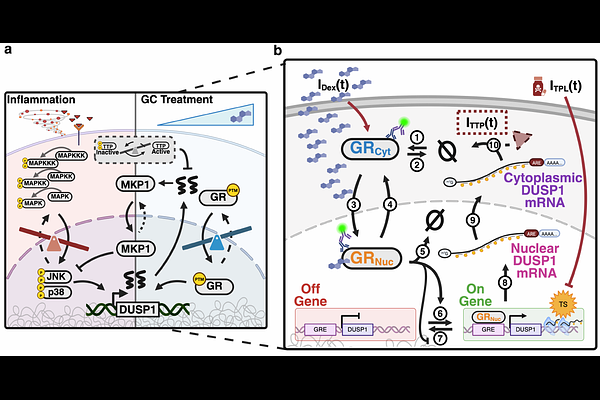
AbstractOver-activation of mitogen-activated protein kinase (MAPK) signaling underlies numerous inflammatory pathologies that are treated using synthetic glucocorticoids to activate glucocorticoid receptors (GR) and induce expression of dual-specificity phosphatase 1 (DUSP1), which encodes for MAPK phosphatase 1 (MKP1). Despite its importance, the single-cell het-erogeneity of this spatial and temporal pathway has not been fully quantified, several regulatory mechanisms are unclear, and accurate quantitative predictions are not possible based on existing models. To address this challenge, we combined immunocytochemistry (ICC) and single-molecule inexpensive FISH (smiFISH) to quantify endogenous GR transport and DUSP1 transcription dynamics across thousands of single cells following dexamethasone (Dex) stimulation. Using Chemical Master Equations (CME) and likelihood-based inference, we identified clear mechanisms and reaction rates for Dex-driven GR nuclear import; compartment-specific GR degradation; GR-dependent modulation of DUSP1 promoter activation and transcription burst frequencies; DUSP1 transcription, elongation, and transport; and time-dependent and saturation-limited cytoplasmic degradation. Rigorous model comparisons against endogenous, fixed-cell data identifies nuclear GR degradation as the dominant mechanism of receptor clearance, indicates that GR primarily regulates promoter activation, and highlights time-dependent AU-rich element (ARE)-mediated mRNA degradation as a likely mechanism for DUSP1 clearance. With these mechanisms, the fully-parameterized model quantitatively predicts joint distributions of GR translation and decay dynamics, DUSP1 transcription site activity, and nuclear and cytoplasmic mRNA heterogeneity among clonal cells as functions of time and across seven orders of magnitude for Dex induction concentrations. Together, these results show that total DUSP1 mRNA levels emerge from the balance between GR-driven activation and cytoplasmic mRNA decay, with the inferred model quantitatively predicting single-cell distributions across held-out conditions.