Empirical estimation of multiple-testing burden for population-based HLA association studies using sequencing-derived HLA alleles across genetic ancestries

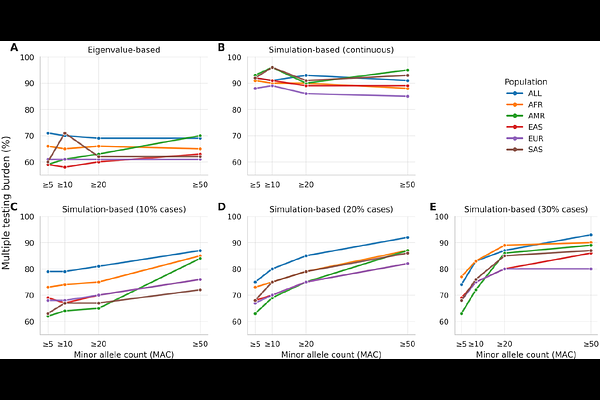
Empirical estimation of multiple-testing burden for population-based HLA association studies using sequencing-derived HLA alleles across genetic ancestries
Taliun, D.; Gagliano Taliun, S. A.
AbstractAs population-scale whole-genome sequencing datasets continue to expand, they enable genetic association studies beyond single-nucleotide variants to more complex forms of genetic variation, including classical human leukocyte antigen (HLA) alleles. The HLA region comprises nine highly polymorphic classical HLA genes in extensive linkage disequilibrium that are associated with numerous autoimmune and infectious diseases. However, unlike genome-wide association studies of single-nucleotide variants, there is no general guidance for controlling the multiple-testing burden in HLA allele association analyses. Here, we systematically evaluated the effective number of independent HLA allele tests using sequencing data from diverse genetic ancestries, analytical derivation and simulations. We show that the multiple-testing burden depends on genetic ancestry, allele frequency, and the phenotype model, but remains remarkably stable across minor allele count thresholds, corresponding to approximately 60-70% of the total number of tested HLA alleles. Simulations further demonstrate that the effective number of tests can exceed 90% under realistic disease models. Analyses of 4-field HLA alleles from long-read sequencing showed that higher typing resolution increases the number of alleles but preserves the underlying correlation structure and scales the effective number of independent tests proportionally. Our results provide practical guidance for HLA association studies and support Bonferroni correction based on the total number of tested HLA alleles as a simple and robust approximation when permutation-based approaches are impractical.