The compositional nature of the human alpha rhythm

The compositional nature of the human alpha rhythm
Menetrey, M. Q.; Pascucci, D.
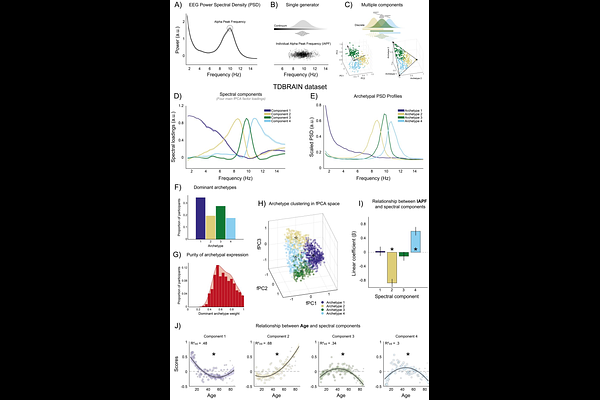
AbstractResting-state brain activity is dominated by oscillations in the alpha band (8-13 Hz). The dominant frequency within this band, the individual alpha peak frequency (IAPF), has been widely used as a global marker of inter-individual variability in perceptual and cognitive functions, as well as clinical phenotypes. However, the traditional approach implicitly assumes a single oscillatory rhythm varying along a parametric continuum. Here, we analyzed resting-state EEG data from more than 2000 participants across multiple independent datasets. We identify three distinct and highly stable alpha components, or archetypes, that jointly and compositionally determine the IAPF. These components exhibit dissociable age-related trajectories as well as distinct scalp topographies and cortical sources. Together, these findings indicate that individual differences in alpha activity do not reflect variation along a single frequency dimension, but rather differences in the relative contribution of discrete alpha generators. This calls for a reevaluation of many reported associations between alpha frequency, brain function, and clinical phenotypes.