History of Traumatic Brain Injury with Loss of Consciousness and APOE ϵ4 Carriers Synergistically Increase Late-Life Amyloid PET Burden

History of Traumatic Brain Injury with Loss of Consciousness and APOE ϵ4 Carriers Synergistically Increase Late-Life Amyloid PET Burden
Strain, J.; Barthelemy, N. R.; jha, R.; Guo, O.; Parihar, M.; Chan, K.; Adeyemo, B.; Millar, P. R.; Womack, K.; Gordon, B. A.; Schindler, S. E.; Morris, j.; Benzinger, T. L. S.; Ances, B.; Phuah, C.-L.
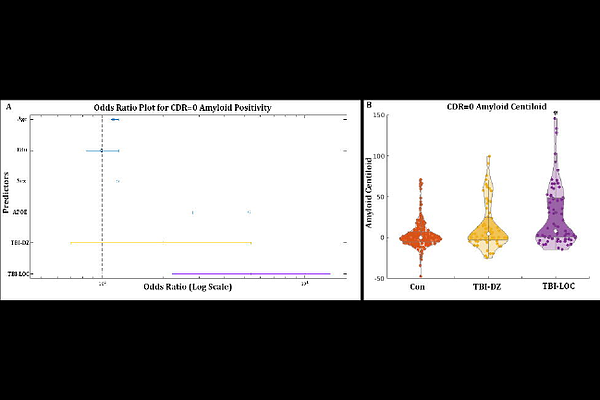
AbstractBackground: Traumatic brain injury with loss of consciousness (TBI - LOC) is an established risk factor for dementia, yet the pathways linking remote TBI to Alzheimer disease (AD) biology remain incompletely defined. APOE {epsilon}4 is the strongest genetic risk factor for late - onset AD and is associated with greater amyloid accumulation; however, it remains unclear whether TBI - LOC amplifies APOE {epsilon}4 -- related vulnerability to amyloid deposition. This study assesses if a remote history of TBI - LOC synergistically interacts with APOE {epsilon}4 to increase late-life amyloid or tau burden. Methods: 429 participants completed the Ohio State University TBI screening tool and a PET amyloid scan quantified in centiloids. TBI history was classified by recency ( < 10 vs > 10 years) and severity (no TBI, dazing/confusion [TBI - DZ], TBI - LOC) with analyses stratified by degree of clinical impairment as assessed by Clinical Dementia Rating (CDR {equiv} 0 vs CDR >0 ). Logistic and linear regression models examined associations between TBI and amyloid, adjusting for age, sex, education, and APOE {epsilon} 4, including an APOE*LOC interaction term, while Fisher exact tests evaluated TBI recency and biomarker positivity. Results: In CDR{equiv}0 participants ( n {equiv} 365), 119 reported a history of TBI, comprising 56 TBI - DZ and 63 TBI - LOC. TBI - LOC but not TBI - DZ, correlated with elevated PET amyloid levels (p < 0.001; [4.6 - 17]). Furthermore, an interaction between APOE {epsilon}4 and TBI - LOC indicated that TBI - LOC augmented the amyloid - related risk associated with the APOE {epsilon} 4 allele (p {equiv} 0.003; [4.3 - 21]). The interaction persisted when stratified by TBI recency with only remote TBI - LOC (occurring more than 10 years prior) associated with increased PET amyloid (p {equiv} 0.003 [5.2 - 25]). No association between TBI and tau was identified in a subset with tau PET, and no TBI - amyloid correlations were observed among symptomatic participants (CDR > 0; n {equiv} 64) suggesting a ceiling effect of pathology once clinical dementia is present. Conclusions: History of remote TBI - LOC is linked to elevated amyloid PET levels in later life, particularly among APOE {epsilon}4 carriers with a CDR {equiv} 0. The specificity for amyloid (as opposed to tau) and its attenuation in cases with a CDR > 0 underscore the value of incorporating TBI history when screening for preclinical AD.