Bioactive produced by Enterococcus Faecalis targets IL-23 signalling and protects against colitis and joint disease

Bioactive produced by Enterococcus Faecalis targets IL-23 signalling and protects against colitis and joint disease
Giri, R.; Bergot, A.-S.; Cuiv, P. O.; Morrison, M.; Thomas, R.; Begun, J.
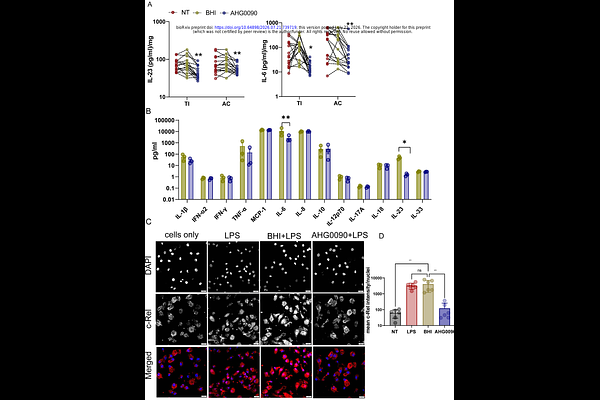
AbstractThe IL-23/Th17 axis is a central driver of intestinal and spondyloarthritic inflammation, yet upstream regulatory mechanisms linking microbial signals to IL-23 production remain incompletely defined. NF-kB signalling, particularly via the c-Rel subunit, is a critical transcriptional regulator of IL23A (p19), positioning c-Rel as a nodal checkpoint in mucosal inflammation. Here, we demonstrate that cell-free supernatant derived from Enterococcus faecalis AHG0090 (AHG0090-CS) suppresses c-Rel-dependent IL-23 signalling and attenuates inflammatory pathology across murine models of gut and joint disease. In the ZAP-70 mutant SKG model of spondyloarthritis and ileitis, AHG0090-CS significantly reduced weight loss, joint scores, and histological gut inflammation following curdlan challenge. In the Winnie model of spontaneous colitis, treatment similarly diminished inflammatory cytokine production. Mechanistically, AHG0090-CS reduced IL-23p19 mRNA and protein expression in intestinal tissue and lamina propria myeloid cells, accompanied by decreased nuclear c-Rel intensity. Suppression extended to downstream IL-23-associated cytokines including IL-17A, GM-CSF, MCP-1 and IL-6. In human peripheral blood mononuclear cells and macrophages, AHG0090-CS attenuated LPS-induced IL-23 and pro-inflammatory cytokine production, supporting translational relevance. Collectively, these findings identify microbial modulation of c-Rel-dependent IL-23 signalling as a tractable mechanism to restrain gut-joint inflammation and highlight targeting upstream NF-kB pathways as a therapeutic strategy in IL-23-driven immune-mediated disease.