Neural-vocal phase coupling reveals structured timing in birdsong production

Neural-vocal phase coupling reveals structured timing in birdsong production
Leites, F. L.; Boaretto, B. R. R.; Masoller, C.; Amador, A.
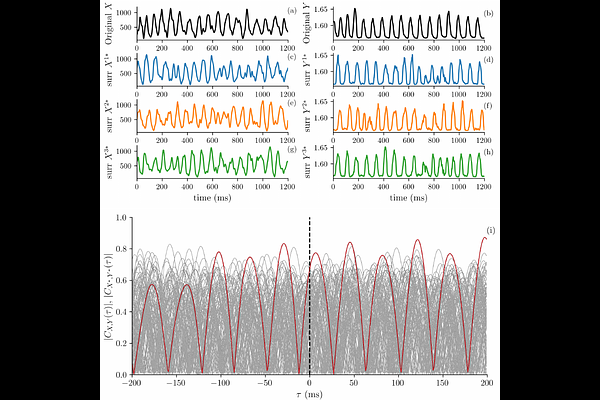
AbstractUnderstanding how neural population activity is temporally coordinated with behavior remains a central challenge in neuroscience. Songbirds provide a powerful model system for addressing this question because learned vocal production requires precise coordination among neural dynamics, temporally structured motor output, and auditory feedback. However, quantifying neural-vocal interactions is challenging because both neural and acoustic signals are rhythmic, noisy, and highly nonstationary. Here, we investigate neural-vocal coordination during spontaneous canary singing using simultaneous recordings of neural population activity in a forebrain region of the song system and vocal behavior. Using a phase-resolved cross-correlation framework combined with surrogate-based statistical validation, we quantify neural-vocal interactions in short and highly variable song segments. Our analysis reveals that neural-vocal interactions are organized into distinct temporal regimes comprising positive, near-zero, and negative lags, consistent with neural activity preceding, accompanying, or following vocal output. The coexistence of these regimes is consistent with the integrative role of the recorded region, which receives auditory input, contributes to premotor control, and participates in the neural circuitry supporting song learning and the ongoing maintenance of adult song. We further find that correlated and anticorrelated interactions coexist throughout singing, with anticorrelated interactions consistently concentrated around near-zero lags. These anticorrelations identify periods in which decreases in neural population activity are closely aligned with sound production, revealing biologically relevant information that is obscured by analyses performed over complete song renditions. Together, these results uncover a robust temporal structure linking neural population activity to vocal behavior and provide a broadly applicable framework for extracting transient neural-behavioral interactions from complex biological signals.