Seasonal blood-brain barrier plasticity links environmental cues to migratory behavior in monarch butterflies

Seasonal blood-brain barrier plasticity links environmental cues to migratory behavior in monarch butterflies
Lugena, A. B.; Goforth, K. M.; Shetty, V.; Zhang, Y.; Gonzalez-Rodriguez, A.; Ramirez, M. I.; Merlin, C.
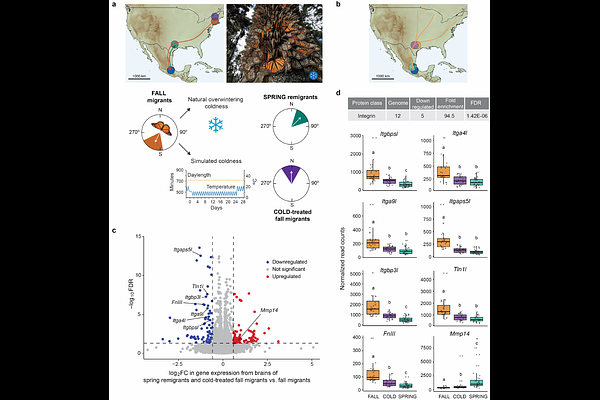
AbstractSeasonal migration requires animals to reversibly switch behavioral states in response to environmental cues, yet the molecular and cellular mechanisms underlying these transitions remain poorly understood. Monarch butterflies provide a powerful model, as Eastern North American populations undergo a long-distance southward migration in the fall followed by a cold-dependent reversal in flight orientation after overwintering each spring. Here, we show that cold exposure induces coordinated transcriptional changes in the monarch brain, marked by attenuated integrin-mediated extracellular matrix (ECM) signaling at the blood-brain barrier (BBB). Cold-exposed monarchs exhibit increased penetration of fluorescent markers into the brain, consistent with increased BBB permeability. Notably, our findings align with previous genomic evidence identifying collagen type IV alpha 1, a major ECM component, as a locus under divergent selection between migratory and non-migratory populations. Together, these results implicate seasonal modulation of BBB permeability as a mechanism linking environmental temperature to plastic migratory behavior and identify the BBB as a dynamic interface through which seasonal cues may reprogram neural function and behavior.