Kinematics-based assessment of reaching and grasping movements in LRN ablated animals identifies a role for the LRN in endpoint stabilization and reach timing.

Kinematics-based assessment of reaching and grasping movements in LRN ablated animals identifies a role for the LRN in endpoint stabilization and reach timing.
Koma, G. T.; Ross, J. D.; Campion, T. J.; Rajavong, J.; Smith, G. M.; Spence, A. J.
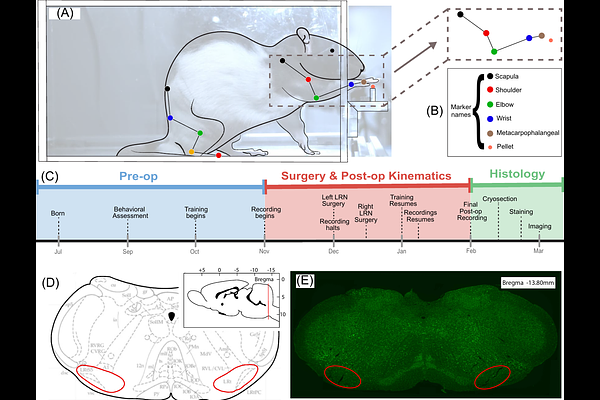
AbstractThe lateral reticular nucleus (LRN) is thought to contribute to skilled forelimb control but its specific contributions to reaching and grasping remain unclear. In this paper, we examine skilled reaching in intact adult female Long-Evans rats after bilateral LRN ablation through single-pellet reaching tasks. Tasks were analyzed using sensitive quantitative kinematic analyses and qualitative behavioral scoring. Overall, limb transport was largely preserved after ablation, with results appearing in temporally restricted differences. The clearest deficits emerged in pellet-directed endpoint control. LRN-ablated animals showed broad variability in endpoint covariance, endpoint spread, and increased trial-to-trial variability, indicating that the movement became less precise and less consistent. These effects were more consistent than any single spatial difference seen, suggesting that ablation of the LRN impairs movement refinement rather than inducing a simple directional bias, although the paw height during the reach was significantly effected. Reach duration also changed, but this temporal difference emerged later and was less prominent. Our results suggest that the LRN acts as an important contributor to endpoint stabilization and reach timing during skilled forelimb behavior.