Quantum-Enhanced Passive and Active Radio-Frequency Photonic Imaging

Quantum-Enhanced Passive and Active Radio-Frequency Photonic Imaging
Visuttha Manthamkarn, Haowei Shi, Shuaifeng Guo, Christopher M. Jones, Quntao Zhuang, Zheshen Zhang
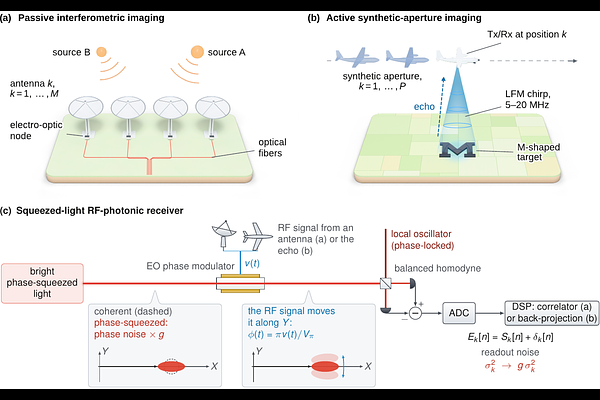
AbstractRadio-frequency (RF) photonics enables broadband, phase-coherent sensing beyond the reach of purely electronic architectures, yet at a given optical carrier power its sensitivity is bounded by the standard quantum limit of the optical readout. Here, we experimentally demonstrate that this limit can be surpassed in both passive and active RF imaging modalities by encoding RF signals onto a bright phase-squeezed optical carrier and recovering them via balanced homodyne detection, while the RF front end, illumination, and image reconstruction remain classical. A unified measurement model shows that phase squeezing reduces the variance of the additive readout noise by a single factor $g$, yielding peak signal-to-noise ratio (PSNR) gains of up to $2G$, where $G\equiv10\log_{10}(1/g)$: between $G$ and $2G$ for deterministic targets in active imaging when the classical noise of the echoes is negligible against the readout noise, and set by the ratio of scene noise to readout noise in passive imaging. We validate the model in an experiment in the 5--20 MHz band, in which synthesized RF scenes are replayed through a physical squeezed-light receiver. With 3 dB of squeezing, the PSNR improves by about 6 dB, close to $2G$, in the readout-noise-dominated regime of both modalities, and the model predicts the measured gains without free parameters. These results identify where squeezed-light readout benefits RF-photonic imaging: wherever the optical readout noise, rather than the scene or the RF front end, dominates the image error.