Intermolecular disulfide bond formation promotes Hsp42 higher-order assembly and shapes client selection in yeast

Intermolecular disulfide bond formation promotes Hsp42 higher-order assembly and shapes client selection in yeast
Duong, L. D.; Escobar-Osorio, D.; Saltzman, A. B.; Morano, K. A.
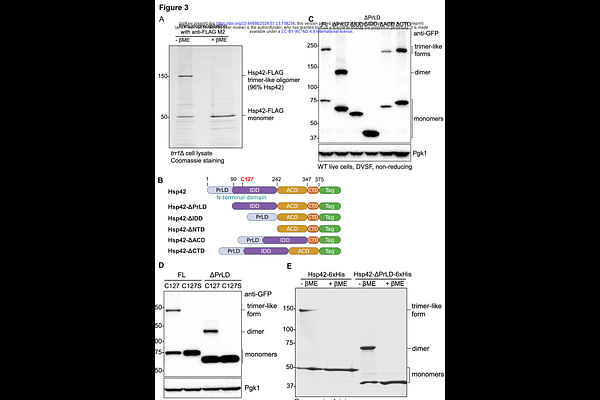
AbstractCellular redox homeostasis plays a critical role in regulating protein function, including chaperone activity, through reversible oxidation of cysteine and methionine residues. Previously, we found that budding yeast cells experiencing redox imbalance due to inactivated thioredoxin reductase ( trr1{triangleup}) activate the heat shock response and induce hyperaccumulation of the small heat shock protein/sequestrase Hsp42 with misfolded proteins. Building on that finding, this study identified cysteine 127 (C127) within Hsp42 as a redox-active residue that becomes oxidized in trr1{triangleup} cells, upon treatment with the powerful oxidant hydrogen peroxide, or by exposure to the cysteine crosslinker divinyl sulfone (DVSF). In trr1{triangleup} cells, C127 oxidation promoted intermolecular disulfide bond formation and contributed to Hsp42 homo-oligomerization. We show that stable oligomerization requires both the prion-like domain (PrLD) and C127 oxidation. While Hsp42-GFP formed prominent persistent foci in trr1{triangleup} cells, replacement of C127 with non-thiol reactive serine decreased foci formation. Furthermore, the C127S mutation diminished Hsp42 oligomerization and sedimentability. Immunoprecipitation coupled with mass spectrometry analysis revealed that Hsp42 in trr1{triangleup} cells preferentially associated with mitochondrial precursor proteins accumulated in the cytoplasm, as well as oxidation-reduction enzymes. The observed client selectivity was altered by the C127S mutation that diversified the spectrum of Hsp42-associated proteins. Collectively, these findings identify Cys127 as a redox-active switch that regulates Hsp42 assembly, foci formation, stability, and client specificity in response to oxidative stress.