Adaptive Remodeling of the MPXV B21R Receptor-Binding Domain Enhances DC-SIGN Interaction and Identifies Conserved CTL Targets for T-Cell Vaccine Development

Adaptive Remodeling of the MPXV B21R Receptor-Binding Domain Enhances DC-SIGN Interaction and Identifies Conserved CTL Targets for T-Cell Vaccine Development
Kumar, S.; Harnam, A. S.; Kumar, S.; Paweska, J. T.; Abdel-Moneim, A. S.; Saxena, S. K.
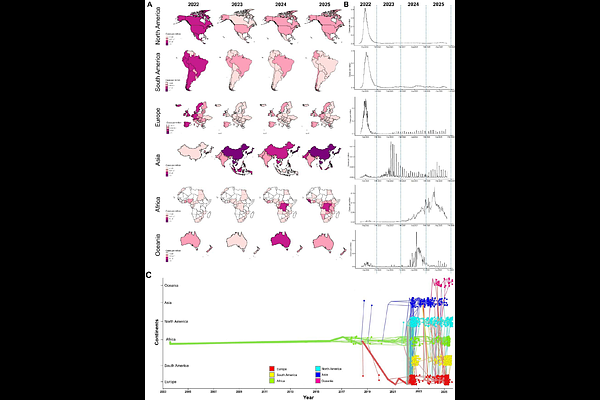
AbstractGlobal Mpox transmission is imposing public health concern as the number of cases is progressively increasing since its first major outbreak in 1996. Therefore, understanding its global epidemiological transformation and its underlying mechanism is crucial to decipher the immune evasion strategies exhibited by recent MPXV strains. In the present study, we analyzed the trend of global Mpox epidemiology and identified the current multinational outbreak which has initiated in 2017 from Africa. To explore the molecular basis of this transformation, we considered the B21R protein of MPXV as it may have played a role in viral adaptation and immune escape mechanism as one of the important MPXV structural proteins. Our data shows that Mpox has significantly transformed from 1996 to 2025, where MPXV strains from 2022, 2023, and 2024 are closely clustered whereas 2025 is closely related to 2017 MPXV strain. Structural modeling of B21R using AlphaFold uncovers a modular architecture comprising a putative receptor-binding N-terminal region (p-RBD), a central ectodomain, and a membrane-anchored C-terminal segment. Mapping solvent accessibility across the full-length B21R protein revealed that p-RBD exhibited highest solvent exposure compared to other B21R protein domains. As a potential cellular receptor for entry into the host targeted cell, we evaluated the interaction of p-RBD of B21R protein with CRD region of DC-SIGN, which showed the gradual increase in the binding affinity with acquired mutations. Moreover, we found alteration in the O-linked glycosylation sites at p-RBD regions of B21R protein which is crucial for the MPXV entry into the host cell. Importantly, we observed significant changes in linear B cell epitopes of p-RBD, impacting the humoral immunity, while CTL epitopes remained conserved. Hence, we showed the significance of B21R p-RBD as a T-cell based vaccine candidate for prevention of Mpox. This study provides novel insights into the recent global transmission of the Mpox and explored a plausible mechanism of humoral immune escape strategies through progressive mutations in the B21R protein and potential development of T-cell based vaccine candidate.