Halophytic endophytes provide transferable immune functions for crop resilience

Halophytic endophytes provide transferable immune functions for crop resilience
Michalopoulou, V. A.; Soultatos, S. K.; Paragkamian, S.; Arapitsas, N. P.; Margaritopoulou, T.; Triviza, M.-F.; Kosenaki, S.; Kalogeropoulou, E.; Markellou, E.; Markakis, E. A.; Sarris, P. F.
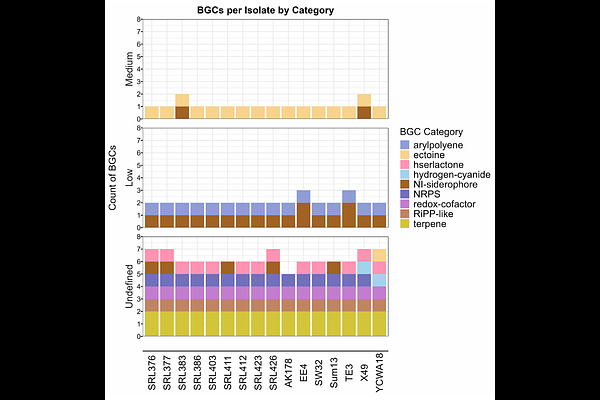
AbstractHalophytic microbiomes represent an untapped reservoir of stress-adapted microbial functions, yet whether these functions can be transferred across ecological boundaries to enhance crop immune resilience remains unknown. Here we show that Kushneria, a halophyte associated genus with broad environmental resilience, confers robust disease protection in tomato and cucumber plants against fungal and oomycete pathogens despite lacking direct antagonistic activity. Comparative genomics across 26 genomes revealed extensive biosynthetic novelty and conserved catabolic clusters associated with rhizosphere competence, providing a genomic framework for persistence of Kushneria in saline environments. Multiomics profiling associated protection with a distinct host immune regulatory response, characterized by strong induction of core NLR receptors, including a ZAR1 paralogue. This response was further linked to a previously uncharacterized long noncoding RNA, Solyc10r048010.1, connected to the induced NLR network. Our findings establish halophytic endophytes as field-validated and transferable modulators of crop immunity and identify a candidate regulatory RNA/NLR axis associated with Kushneria-induced disease resistance.