Sound-evoked facial motion in ferrets: evidence for species differences in sensorimotor coupling

Sound-evoked facial motion in ferrets: evidence for species differences in sensorimotor coupling
Martin, M.; Boubenec, Y.
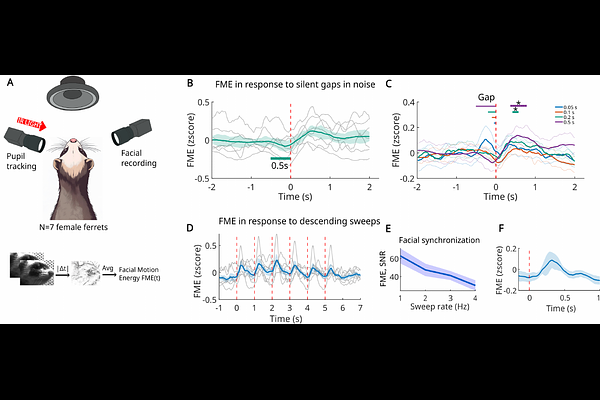
AbstractA growing body of evidence from mice shows that uninstructed movements tightly covary with cortical activity, raising the question of how much apparent sensory encoding reflects behaviorally driven signals. Whether this coupling generalizes beyond rodents remains unclear. Here we characterize sound-evoked facial motion and pupil dynamics in head-fixed ferrets passively exposed to broadband, natural, and synthetic auditory stimuli. Ferrets reliably produced facial motion responses to sounds, but unlike mice, these responses were dominated by a single onset-locked component peaking at 200-300 ms, tracked only low-frequency temporal modulations below 2 Hz, and carried no information about sound identity or category. Paradoxically, synthetic sounds, which preserved spectrotemporal statistics but lack higher-order natural structure, elicited significantly stronger responses than their natural counterparts, suggesting that ferret behavioral responses reflect acoustic novelty rather than ecological salience. Pupil dynamics mirrored facial motion, consistent with a shared arousal mechanism. Together, these results place ferrets closer to primates than to mice in the degree of sound-movement coupling, and suggest that the tight sensorimotor integration observed in rodents may reflect a species-specific organization rather than a general mammalian principle.