Impact of Image Representation on Deep Learning-Based Single-Cell Classification by Holographic Imaging Flow Cytometry

Impact of Image Representation on Deep Learning-Based Single-Cell Classification by Holographic Imaging Flow Cytometry
Pirone, D.; Cavina, B.; Giugliano, G.; Nanetti, F.; Reggiani, F.; Miccio, L.; Kurelac, I.; Ferraro, P.; Memmolo, P.
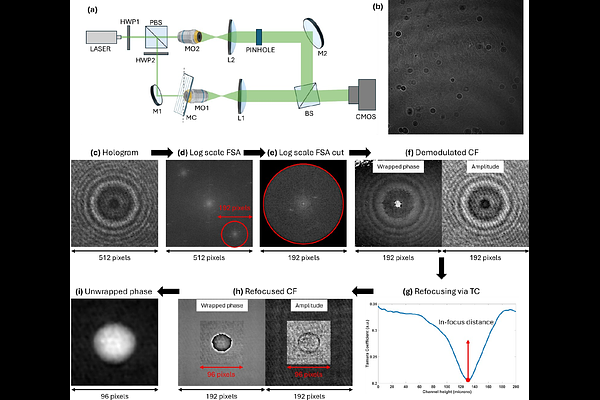
AbstractAccurate cell type classification is essential for a wide range of biomedical applications, including disease diagnosis, drug discovery, and the study of cellular processes. Holographic imaging flow cytometry (HIFC) provides label-free quantitative phase imaging (QPI) of individual cells, enabling classification based on phase images. However, reconstructing holograms into phase images involves multi-step image processing, which introduces substantial computational overhead. The availability of diverse image representations across holographic reconstruction stages allows for flexible analytical strategies, enabling the optimization of trade-off between classification accuracy and computational efficiency. Moreover, deep learning offers an efficient alternative, accelerating the reconstruction process while performing accurate classification. However, despite its importance, this optimization challenge remains largely unexplored in the current literature. Here, we present the first systematic evaluation aimed at balancing classification accuracy with computational efficiency, highlighting how different image representations affect overall performance. We focus on a binary classification task discriminating natural killer cells from breast cancer cells. Six distinct classification pipelines are evaluated: direct processing of raw holograms, analysis of demodulated complex fields (CFs), refocused CFs, unwrapped phase images, and two deep learning-based methods that either replace the automatic refocusing stage or perform end-to-end hologram-to-phase reconstruction. For each strategy, we assess both computational cost and classification performance. Our results reveal a clear trade-off: reconstructed phase images provide the highest accuracy, whereas simpler representations or accelerated reconstruction methods significantly reduce processing time with minimal loss of accuracy. A Pareto analysis identifies the optimal set of strategies, offering practical guidelines for selecting image representations and processing pipelines based on available hardware and desired performance. Thus, this work offers a systematic framework for high-throughput deep learning classification in HIFC, serving as a potential reference for future biomedical applications.