A Grass-Specific Structural Feature of Myosin VIII Regulates Protoxylem Development and Hydraulic Conductance in Sorghum

A Grass-Specific Structural Feature of Myosin VIII Regulates Protoxylem Development and Hydraulic Conductance in Sorghum
Liu, Z.; Tian, R.; Leonidas, D.; Zhanguo, X.; Chen, J.; Patil, G. B.; Jiao, Y.
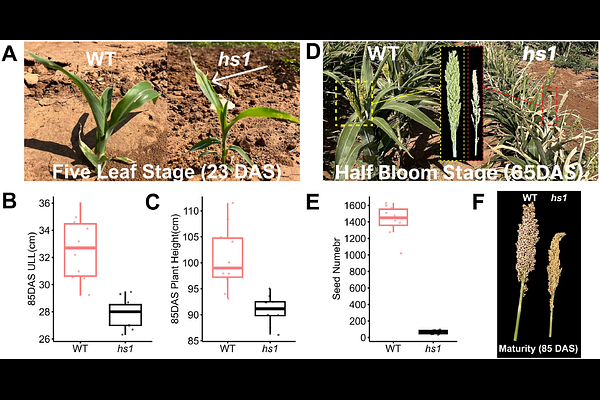
AbstractSorghum (Sorghum bicolor), a C grass adapted to hot semi-arid environments, depends on reinforced xylem vessels to maintain hydraulic conductance under high evaporative demand. During protoxylem differentiation, coordinated microtubule and actin dynamics guide secondary cell wall (SCW) deposition; however, whether actin-based motors directly regulate vascular architecture and hydraulic performance has remained unknown. Here, we identify HEAT-SENSITIVE 1 (HS1), a previously uncharacterized myosin VIII, as a central regulator of protoxylem integrity and water transport in sorghum. The hs1 mutant exhibited severe leaf scorching under field conditions. The hs1 mutant displayed severe leaf scorching under field conditions, accompanied by pronounced protoxylem defects under controlled environments, including vessel collapse, reduced lumen area, and attenuated lignified SCWs. These structural abnormalities compromised longitudinal hydraulic conductance, diminished whole-plant water use, and rendered expanding leaves unable to meet transpirational demand, resulting in transient water deficit and thermal injury. HS1 encoded a grass-specific myosin VIII with a grass-specific N-terminal extension exhibiting high intrinsic disorder and lineage-specific substitutions in the motor domain. Molecular and single-cell transcriptome analyses positioned HS1 within differentiating protoxylem cells of developing leaves, revealing pronounced temporal and cell-type specificity. Furthermore bulk transcriptome profiling and quantitative lignin measurements indicated that HS1 promoted lignin-associated SCW biosynthesis during protoxylem differentiation, functionally linking actin-based motor activity to wall reinforcement. HS1 encodes a grass-specific myosin VIII distinguished by an extended intrinsically disordered N-terminal region and lineage-specific substitutions within the motor domain, suggesting evolutionary specialization. Consistant with core developmental role, reduced nucleotide diversity at the HS1 locus across diverse sorghum accessions further supported strong evolutionary constraint. Together, these findings established HS1 as the first actin-based motor protein shown to control xylem architecture and hydraulic function in plants.