The ecology of remembering and forgetting: quantity-quality trade-offs in the spatiotemporal memory of a forager

The ecology of remembering and forgetting: quantity-quality trade-offs in the spatiotemporal memory of a forager
Ozturk, K. C. D.; van Pinxteren, B. O. C. M.; Janmaat, K. R. L.; Robira, B.
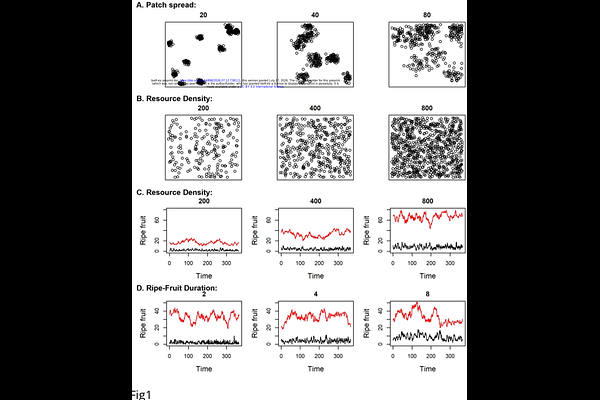
AbstractOne way that animals can cope with the challenge of locating ephemeral food in time and space is by tracking elapsed time and planning revisits to these resources. These abilities likely evolved under constraints of memory capacity. We expect that during evolution a trade-off emerged between a large memory size (quantity) and high accuracy (quality) of information. We used computer simulations of a forager moving through space and time to investigate how timing accuracy, memory size, and forgetting affect foraging efficiency across environmental conditions, and how foragers should trade off the quantity against quality of memorised information. Memory in general paid off, as it improved foraging efficiency. However, surprisingly, the largest accuracy and size were not always most beneficial. In resource-poor, heterogeneous, and highly dynamic environments, extensive memory was even detrimental, as individuals likely became trapped in overexploited familiar areas. This suggests that under certain environmental conditions, a hidden, non-energetic cost of memory can arise. Furthermore, environmental structure shaped a quantity-quality trade-off such that a minimal memory size and higher timing accuracy were favoured in resource-poor, temporally stable and homogenous environments. Finally, forgetting was beneficial when memory was constrained, and environments were poor, heterogenous and dynamic. Forgetting limited the benefits of increased memory size, highlighting that memory costs can emerge from how it shapes movement patterns and foraging decisions. Overall, our results highlight that larger and more accurate memory is not necessarily better and that forgetting can be adaptive. This study takes a first step toward the theoretical consideration of memory trade-offs in order to research how they shape, and are shaped, by foraging pressures.