Testing the Transverse Scalar Mode of Gravitational Quantum Field Theory with Taiji and LISA

Testing the Transverse Scalar Mode of Gravitational Quantum Field Theory with Taiji and LISA
Cong Xu, Yong Tang, Yue-Liang Wu
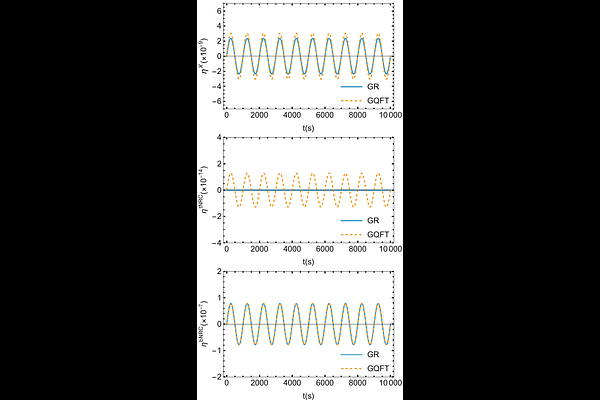
AbstractSpace-based gravitational-wave (GW) detectors, including LISA and Taiji, offer unprecedented access to regimes where alternative theories of gravity may deviate from General Relativity (GR). Gravitational Quantum Field Theory (GQFT) provides a novel framework in which the Poincaré-type inhomogeneous spin symmetry of Weyl-type fermions in the Standard Model is elevated to a gauge symmetry. Within this construction, the fundamental gravitational field is identified with a gravigauge field which behaves as a Goldstone-type bi-covariant vector field. Unlike GR, GQFT predicts additional polarization states: one transverse scalar (breathing) mode and two vector modes. In this work, we focus on the transverse, isotropic scalar mode and investigate its detectability with Taiji. To isolate this mode, we employ the null-response channel (NRC), a specific interferometric combination designed to suppress contributions from other polarizations. We implement an analytical, dynamic orbital model to realistically simulate a triangular constellation. We compute the response functions and sensitivity curves for various interferometric channels, compare them with the standard Michelson channel, and demonstrate the effectiveness of the NRC approach. Our results show that the NRC provides a reliable, waveform-independent criterion for testing non-GR polarizations, and we anticipate that it will serve as a valuable tool for probing gravitational theories in future space-based GW missions.