Short Gravitational-Wave Transients as Probes of Cosmic Domain Walls

Short Gravitational-Wave Transients as Probes of Cosmic Domain Walls
Tore Boybeyi, Doga Veske, David Maibach
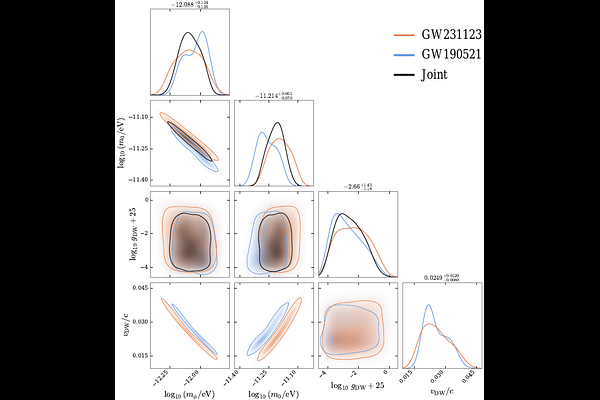
AbstractGW190521 and GW231123 have been reported as short-duration gravitational-wave transients consistent with very massive binary black hole (BBH) coalescences whose inferred parameters, i.e., exceptionally high total masses and spin magnitudes, challenge standard isolated binary stellar evolution. We test a topological dark matter (TDM) interpretation invoking cosmic domain walls by fitting a physically motivated domain wall template to the LIGO Hanford and Livingston strain data. The BBH hypothesis is individually favored, with $\log_{10}\mathcal{B}_{\rm BBH/TDM}=12.2$ and $11.3$ for GW231123 and GW190521, respectively. However, these values are lower than those typically recovered from matched maximum a posteriori BBH waveforms injected into nearby noise segments. We further perform, for the first time, a joint fit in which domain wall signals from a single underlying scalar field are constrained simultaneously by both events. Although not favored over BBH signals, we find the two events are consistent with a common scalar field, with shared TDM parameters agreeing across independent noise realizations and sky locations. We further find that injected TDM transients are systematically recovered under the BBH hypothesis with large spin parameters, revealing a morphological degeneracy that could mask genuine domain wall signals. This analysis demonstrates that multi-event parameter consistency tests provide a new discriminant for domain wall dark matter searches in upcoming observing runs.