Diversity Between but Not Within Microbial Communities Increases With the Diversity of Supplied Nutrients

Diversity Between but Not Within Microbial Communities Increases With the Diversity of Supplied Nutrients
Newbury, A.; Buckling, A.
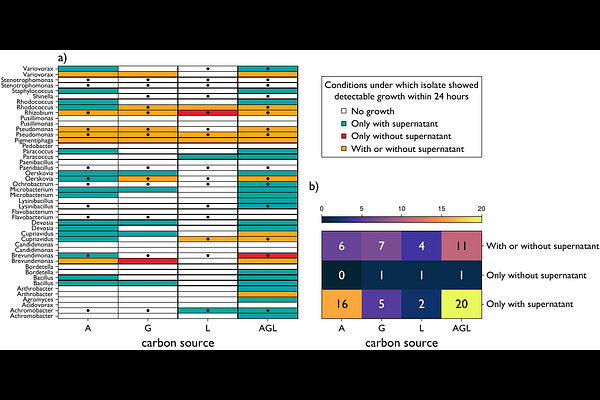
AbstractGreater resource diversity within a habitat is typically expected to support greater biodiversity in the resident ecological community (alpha-diversity). It may also make community composition less deterministic since a wider range of species have a chance establishing themselves and affecting subsequent community assembly processes. However, the relationship between microbial diversity and the diversity of resources exogenously supplied is complicated by cross-feeding between microbes, since much of the resource diversity encountered will be generated by the community. Here, we assembled microbial communities in simple growth media (where cross-feeding will be important) with 1 to 3 carbon sources and asked how increasing nutrient diversity affects diversity within and between communities. While there was (i) no clear difference in alpha-diversity, increasing the number of carbon sources led to communities that varied (ii) more within and (iii) less between the different abiotic conditions. (i) is at odds with classical ecological theory, but fits predictions from a consumer-resource model that accounts for cross-feeding. (ii) shows an increase in the stochasticity of community assembly. (iii) demonstrates strong abiotic selection in the single carbon source communities. We then went on to show that this is leads to phylogenetic clustering (co-occurrence of more closely related strains).