Intrinsic ignition-based propagation networks reveal hierarchical propagation pathways of spontaneous activity in the human brain

Intrinsic ignition-based propagation networks reveal hierarchical propagation pathways of spontaneous activity in the human brain
Liu, J.; Chen, X.; Liao, X.
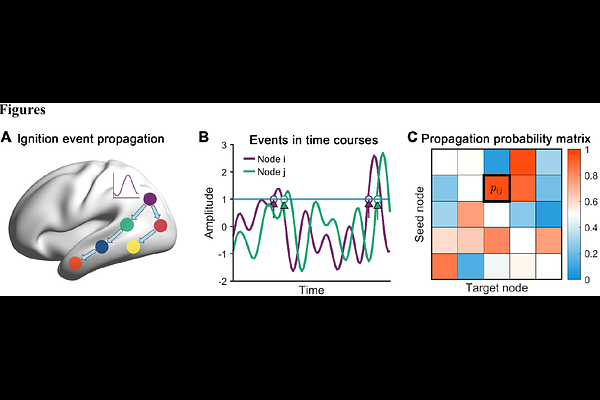
AbstractDirected communication across brain regions is fundamental to human brain function, yet how local spontaneous activity links to directed whole-brain propagation patterns remains elusive. Prior studies have characterized local propagation events and global wave-like dynamics, but a framework linking local events, interregional propagation pathways, and canonical large-scale propagation patterns remains lacking. Using resting-state functional MRI data from the Human Connectome Project 7T cohort and an intrinsic ignition framework, we quantified cascades of suprathreshold activity events and constructed directed propagation probability networks. We found spatially heterogeneous regional propagation preferences, with high outgoing propagation preferences predominantly localized in somatomotor, visual, and default-mode regions. At the functional system level, propagation modules broadly separated visual, somatomotor, dorsal attention, and ventral attention networks from association systems. Regional stepwise propagation pathways were aligned with the principal functional gradient, and greater hierarchical separation between regions was associated with longer propagation distance. These pathways formed two canonical propagation patterns linking primary and association systems, with somatomotor regions preferentially initiated in bottom-up propagation, default-mode regions in top-down propagation, and attention networks occupying intermediate positions. Notably, the two patterns were not simple mirror images, with top-down propagation showing substantial deviations within somatomotor and visual systems. These findings were replicated in an independent cohort. Moreover, individual propagation architecture predicted cognitive performance and tobacco-use behavior. Collectively, our findings provide cross-scale insights into spontaneous activity propagation in the human brain by bridging local ignition events with hierarchical whole-brain propagation pathways and behaviorally relevant individual differences.