A Denisovan-derived Alu insertion in OCA2 contributes to pigmentation diversity in present-day Melanesians

A Denisovan-derived Alu insertion in OCA2 contributes to pigmentation diversity in present-day Melanesians
Kim, K.; Pfennig, A.; Syed, S. A.; Moskwa, N.; Oliveira, N. A. J.; Pham, Q.-M.; Hallast, P.; Yilmaz, F.; McDonough, J.; Norton, H. L.; Akey, J. M.; Lee, C.
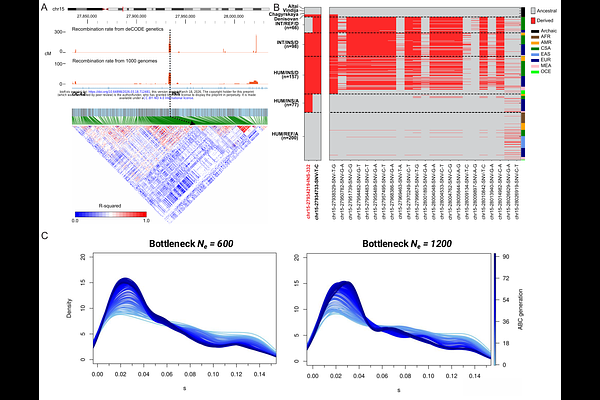
AbstractModern humans inherited DNA from Neanderthals and Denisovans, but the contribution of introgressed structural variants (SVs) to present-day human phenotypes and adaptation remains poorly understood. Here, we used a graph-genome approach to genotype 96,277 SVs in 3,332 present-day humans and three high-coverage archaic hominin genomes, identifying 153 candidate introgressed SVs. These SVs are enriched for signatures of local adaptation compared to non-introgressed SVs (p-value = 3.04 x 10⁻⁷). Among these, we focused on a Denisovan-derived Alu insertion located in intron 18 of OCA2, a gene central to pigmentation. This introgressed Alu insertion is most frequently observed (> 60%) in Indigenous people from Bougainville Island of Melanesia, and is significantly associated with increased skin pigmentation in this region. To assess its functional impact, the Alu insertion was introduced into human induced pluripotent stem cells (iPSCs), which were subsequently differentiated into melanocytes. Melanocytes harboring the Alu insertion demonstrated elevated OCA2 expression, increased pigmentation, and higher levels of enhancer activity compared to controls. Collectively, these findings highlight introgressed SVs as a significant source of adaptive and phenotypic diversity in modern humans and implicate the Denisovan-derived Alu insertion in OCA2 in pigmentation variation among present-day Melanesian populations.