Post-mortem infant-directed behaviours in wild Guinea baboons

Post-mortem infant-directed behaviours in wild Guinea baboons
Aviles de Diego, A.; Dal Pesco, F.; Fischer, J.
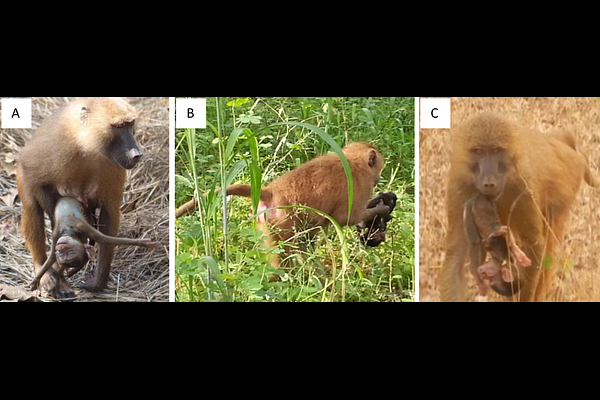
AbstractThe growing field of comparative thanatology aims to shed light on how and why the understanding of death evolved. Observations across different nonhuman primate species have reported care-taking behaviour of dead infants, but also cannibalism. Various hypotheses have been put forward to explain these infant-directed behaviours, ranging from responses to infantile cues to an understanding of death. To aid comparative analyses and test some of these hypotheses, we report behaviours directed at dead infants in a wild population of Guinea baboons (Papio papio) living in the Niokolo-Koba National Park, Senegal. During 12 years of field observations (2014-2025), 67 infants died before reaching 1 year of age. In 4 cases, we could not establish when the infants had died because the field station was closed due to the COVID-19 pandemic. In 22 of the remaining 63 cases, mothers, but occasionally also other group members, carried, protected, groomed, and dragged dead infants. In 6 cases, cannibalism occurred. None of the mothers expressed any signs of emotional distress in response to infant death. We suggest that a concept of death in Guinea need not be invoked to explain the observed behaviours. Instead, selection appears to have favoured post-mortem caretaking behaviours to avoid abandoning an infant that might temporarily be unresponsive. The lack of infant responses to maternal behaviour and the disintegration of the corpse may drive the transition from perceiving the infants as an object that evokes caretaking to one that resembles food, which ultimately facilitates occurrences of cannibalism.