Residual ellipticity in waveplate-compensated polarization-resolved SHG microscopy may arise from femtosecond laser spectral bandwidth

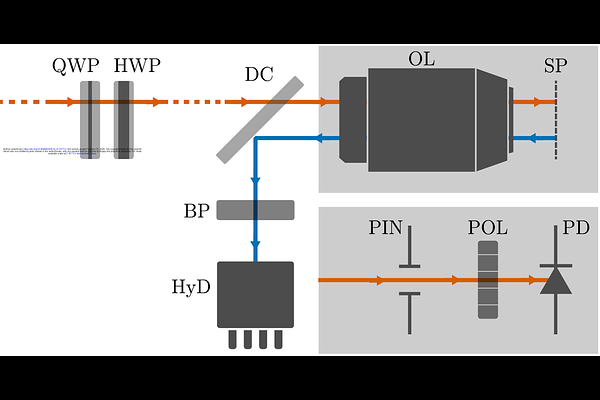
Residual ellipticity in waveplate-compensated polarization-resolved SHG microscopy may arise from femtosecond laser spectral bandwidth
Nguyen, D.; Wilde, J. P.; Uhlmann, V.; Smith, D. J.; Kusch-Wieser, J.; Zanre, V.; Schwiedrzik, J.; Csucs, G.
AbstractPolarization-resolved second harmonic generation microscopy provides structural information about non-centrosymmetric biological samples such as collagen. It involves illuminating the sample with a focused laser beam having a variable linear polarization angle and recording the second harmonic signal as a function of this angle. However, accurate linear polarization control is challenging due to ellipticity introduced by reflections from mirrors and dichroic mirrors in the optical path. Waveplate-based compensation has emerged as the standard approach to address these distortions, but its effectiveness for quantitative measurements remains incompletely characterized. Here, we attempt to fill this gap by implementing an established automated waveplate compensation method based on a rotating half-waveplate in combination with a compensating quarter-waveplate. This was done on a commercial Leica TCS SP8 MP multiphoton microscope, making various hardware improvements and carefully documenting important experimental details. Despite significant effort, we consistently observed substantial unwanted residual polarization ellipticity, with amplitudes up to 0.25, persisting under optimal waveplate configurations. Our simulation analysis provides evidence that this limitation may arise from wavelength-dependent dichroic mirror birefringence combined with the broad spectral bandwidth (10 nm to 20 nm full width at half maximum) of femtosecond laser pulses. While the approach investigated here can compensate a single wavelength, different spectral components within the pulse experience different phase retardations from wavelength-dependent optical elements, potentially resulting in residual ellipticity that cannot be eliminated. Our simulations qualitatively reproduced key features of the experimental observations. These findings have important implications for quantitative polarization-resolved second harmonic generation microscopy and suggest that alternative approaches, including specimen rotation or picosecond laser sources with narrower bandwidth, should be investigated for applications requiring precise polarization control. To facilitate community investigation of these effects, we provide open-source analysis code and simulation files.