Weak interactions drive selective proteome demixing and tune the differential response to environmental perturbations

Weak interactions drive selective proteome demixing and tune the differential response to environmental perturbations
Narduzzi, G.; Zucca, F.; Willig, L.; Gillet, L.; Karemaker, I.; Rebane, A. A.; Tomas Sitjes, A.; Young, L.; Becker, M.; Reber, S.; Michaels, T.; Picotti, P.; Neurohr, G. E.
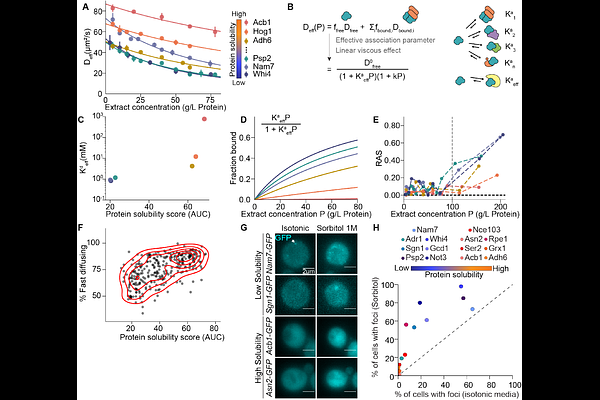
AbstractThe intracellular space is a crowded environment where macromolecules perform distinct tasks despite pervasive "non-specific" interactions. Whether these interactions are functionally relevant and how they influence cellular organization remains unclear. Here, we developed QuPID-MS, which measures the propensity of proteins to phase separate in native cell extracts proteome-wide. We find that weak interactions drive condensation of half of the proteome in a crowding- and temperature-dependent manner and we present evidence that this proteome demixing occurs in cells. Importantly, protein condensation properties are conserved and broadly change when cells adapt to new environments, demonstrating that weak interactions are regulated and linked to function. Indeed, condensation of the growth regulator TORC1 coincides with its rapid inactivation, while high solubility of the stress-activated Hog1 ensures its activity across conditions. We thus uncover a fundamental organizing principle that allows tuning of cell growth to environmental fluctuations while ensuring other processes function robustly despite perturbations.