Higher order repeat structures reflect diverging evolutionary paths in maize centromeres and knobs

Higher order repeat structures reflect diverging evolutionary paths in maize centromeres and knobs
Piri, R. D.; Romay, C.; Buckler, E. S.; Dawe, R. K.
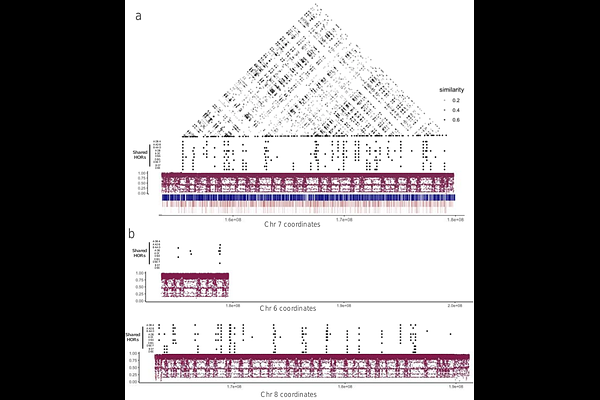
AbstractBackground: Highly repetitive tandem repeat arrays, known as satellite DNAs, are frequently found in low recombination regions such as centromeres. Satellite arrays often contain complex internal structures known as higher order repeats (HORs) that may have functional significance. Maize is unusual in having satellites in two different genomic contexts: centromeres, which interact with kinetochore proteins, and knobs, which are subject to meiotic drive when abnormal chromosome 10 is present. Whether HOR patterns exist in maize centromeres or knobs and how the patterns might relate to function is unknown. Results: Here, we generated 13 repeat-sensitive genome assemblies of maize and its recent ancestor, teosinte. We developed a local, binned approach to categorize HORs. Our findings reveal that HORs are ubiquitous in maize, but are generally low-frequency with small patterns, rather than the large, continuous HOR blocks found in humans and Arabidopsis. While centromeric CentC arrays contain majority HOR content, some of which is conserved in teosinte, the patterns are primarily locally-confined and unrelated to the active centromeres, as marked by Centromeric Histone H3. Knobs, on the other hand, have a more active HOR landscape. Large knobs contain megabase-scale repeat units, or similarity blocks, with conserved HORs. The large-scale repeat units may facilitate unequal crossing over events that enable rapid expansion, and possibly contain functional motifs that are recognized by trans-acting factors that mediate meiotic drive. Conclusions: HORs are present in all satellites in maize. HOR content is not associated with centromere function, but knobs contain conserved HOR patterns within similarity blocks that may facilitate meiotic drive.