Analog regular black holes and black hole mimickers in a Bose-Einstein condensate: from the core to the light rings

Analog regular black holes and black hole mimickers in a Bose-Einstein condensate: from the core to the light rings
Valentin Pomakov, Stefano Liberati
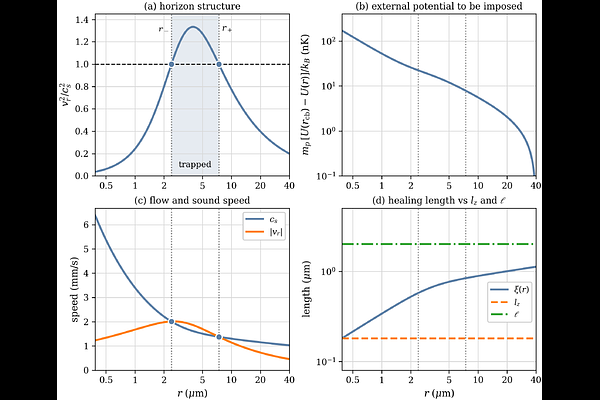
AbstractWe show how static, spherically symmetric regular black holes and black-hole mimickers with radius-dependent mass function $m(r)$ can be emulated in a quasi-two-dimensional Bose--Einstein condensate, with the aim of probing inner-horizon and inner-light-ring instabilities in the laboratory. Matching the acoustic and gravitational line elements on an equatorial disc fixes the ratio of radial flow velocity to sound speed and reproduces both horizon locations and surface gravities exactly. The analogue geometry nevertheless contains a residual radially varying sound-speed factor in $g_{tt}$, which shifts the light-ring positions and reduces the range of the regularization parameter $\ell/M$ for which a light-ring pair exists. We derive the interaction profile that removes this shift. Combining the metric correspondence with the continuity and Bernoulli equations, we then obtain closed-form expressions for the external potential and interaction strength realizing the full target spacetime, with $M$ and $\ell$ directly tunable through parameters of the potential. Finally, we translate the construction into experimental requirements (quasi-two-dimensional confinement, healing-length resolution, three-body lifetime, and stationary-flow lifetime) and present three fiducial designs achievable with present-day $^{39}\mathrm{K}$ platforms.