Activity in the reticulospinal tract scales with handgrip force in humans

Activity in the reticulospinal tract scales with handgrip force in humans
Danielson, T. L.; Gould, L.; DeFreitas, J. M.; MacLennan, R. J.; Borowsky, R.; Farthing, J. P.; Andrushko, J. W.
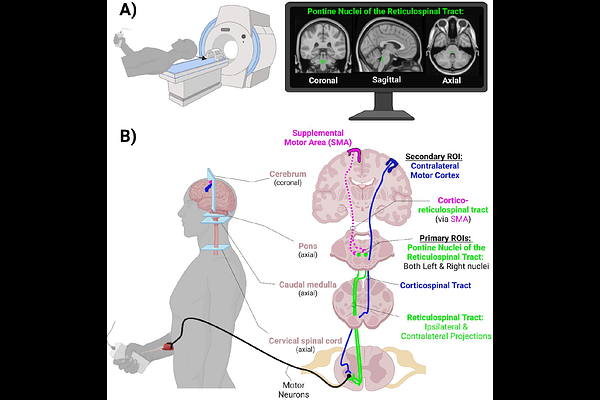
AbstractIntroduction: The neural pathways that contribute to force production in humans are currently poorly understood, as the relative roles of the corticospinal tract and brainstem pathways, such as the reticulospinal tract (RST), vary substantially across species. Using functional magnetic resonance imaging (fMRI) we aimed to measure activation in the pontine reticular nuclei during different submaximal handgrip contractions to determine the potential role of the RST in force modulation. Methods: Thirteen neurologically intact participants (age: 28 {+/-} 6 years) performed unilateral handgrip contractions at 25%, 50%, 75% of maximum voluntary contraction during brain scans. We quantified the magnitude of RST activation from the contralateral and ipsilateral sides in addition to the contralateral primary motor cortex during each of the three contraction intensities. Results: A repeated measures ANOVA demonstrated a significant main effect of force (p = 0.012, {eta}p2 = 0.307) for RST activation, independent of side (i.e., activation increased with force for both contralateral and ipsilateral nuclei). Further analyses of these data involved calculating the linear slope between the magnitude of activation and handgrip force for each ROI at the individual-level. One-sample t-tests on the slopes revealed significant group-level scaling for the RST bilaterally, but only the ipsilateral RST remained significant after correcting for multiple comparisons. Conclusions: Here, we show evidence of task dependent activation in the RST pontine nuclei that was positively related to handgrip force. These data build on a growing body of literature that highlights the RST as a functionally relevant motor pathway for force modulation in humans.