Light-dependent changes in the higher-order DNA structure of the cyanobacterium Synechocystis sp. PCC 6803

Light-dependent changes in the higher-order DNA structure of the cyanobacterium Synechocystis sp. PCC 6803
Kariyazono, R.; Tanabe, H.; Osanai, T.
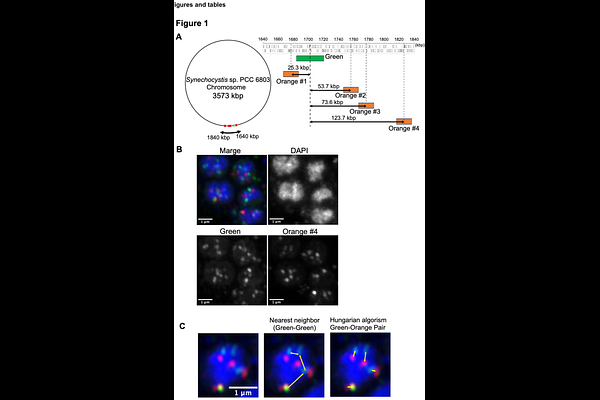
AbstractChromosome spatial organization plays critical roles in transcriptional regulation and DNA protection. In cyanobacteria, oxygenic photosynthetic bacteria that experience dramatic fluctuations in light intensity, chromosome reorganization may facilitate rapid transcriptional reprogramming and protect DNA from photodamage. However, direct observation of chromosome organization in these polyploid organisms has remained technically challenging, leaving light-dependent chromosomal responses unexplored. Here we show that local chromosome organization in Synechocystis sp. PCC 6803 is reorganized in response to high-light stress. We established fluorescence in situ hybridization (FISH) methods for this model cyanobacterium carrying multi-copy genomes, together with a computational pipeline for optimal same-genome-copy probe pairing. Under standard conditions, spatial distance between paired signals increased with genomic distance (slope; 0.972 nm/kbp, R2 = 0.12), demonstrating that linear genome organization is reflected in three-dimensional chromosome structure at the 25 to 124 kbp scale. This genomic-spatial distance relationship substantially weakened under high-light conditions (slope; = 0.450 nm/kbp, R2 = 0.02), indicating that local chromosome organization is disrupted by elevated light intensity. Same-color nearest-neighbor distances further revealed that the spatial distribution of genome copies differed between conditions, independently supporting condition-dependent chromosome reorganization. Hi-C analysis corroborated these findings, revealing reduced short-range interactions within the 10-100 kbp genomic range under high-light conditions. Our integrative single-cell and population-level approach provides a framework for investigating how environmental signals modulate higher-order chromosome structure in polyploid bacteria.