Evidence of two centromeres in the germline-restricted chromosome (GRC): insights from zebra finch lampbrush chromosomes

Evidence of two centromeres in the germline-restricted chromosome (GRC): insights from zebra finch lampbrush chromosomes
Takki, O.; Volodkina, V.; Rubtsov, N.; Zadesenets, K.; Ruiz-Ruano, F. J.; Vontzou, N.; Jukova, J.; Kulak, M.; Gaginskaya, E.; Suh, A.; Galkina, S.
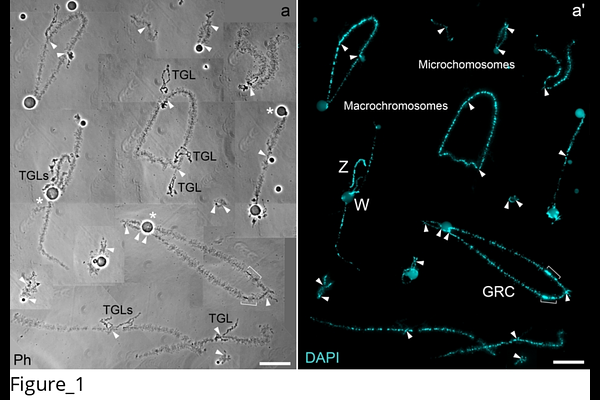
AbstractThe germline-restricted chromosome (GRC) of the zebra finch Taeniopygia guttata represents a well-established model of programmed DNA elimination in vertebrates. Although the DNA composition of the GRC, as well as elimination processes during spermatogenesis and early embryogenesis, have been characterised previously, little is known about the cytogenetic features underlying its unusual behaviour, including its stable transmission through the maternal germline. Here, we provide a detailed characterisation of the zebra finch GRC at the diplotene stage of female meiosis, when chromosomes are actively transcribed and acquire the form of giant lampbrushes. We identified a transcriptionally repressed region on the GRC, which we term the 'belt'. Microdissection and sequencing of the belt revealed that it is predominantly composed of a tandem repeat derived from the dph6 gene, robo1 gene fragments, and ERVs. Notably, the terminally located functional centromere of the GRC lacks typical zebra finch centromeric satellites and, conversely, consists of the newly identified GRC-specific tandem repeats Tgut16-201 and Tgut17-167. The canonical centromeric repeat Tgut716 was observed in the GRC belts. Moreover, belts, like the terminal GRC centromere, were associated with coilin-containing nuclear bodies, which serve as markers of centromeric regions on zebra finch lampbrush chromosomes. Together, our findings provide evidence for the presence of one functional and one putative centromeric region on the zebra finch GRC, suggesting their role in non-Mendelian inheritance of the GRC.