The TONSL-MMS22L complex and FANCM form an interdependent complex on chromatin to counter replication stress

The TONSL-MMS22L complex and FANCM form an interdependent complex on chromatin to counter replication stress
Zhou, H.; Yan, J.; Cao, X.; Zhan, J.; Ling, C.; Luo, Y.; Ma, Z.; Sun, Y.; Song, P.; Liu, W.; Wang, L.; Li, J.; Shaik, A.; Bellani, M.; Wang, L.; Xie, Y.; Zhang, J.; Xue, X.; Shen, X.; Seidman, M. M.; Wang, W.; Yan, Z.
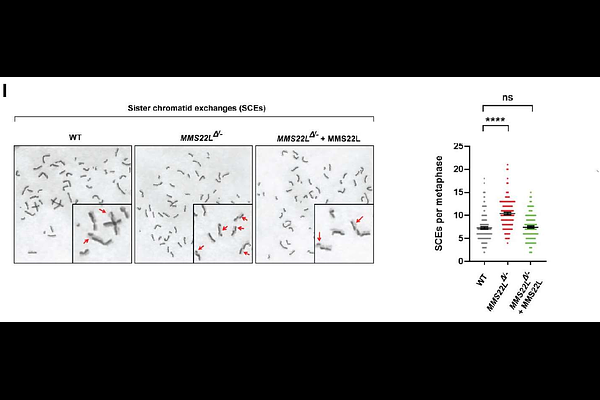
AbstractFANCM is branchpoint DNA translocase essential for cellular response to replication stress. Here, we show that replication stress stimulates FANCM and the TONSL-MMS22L heterodimer bound to histones H3-H4 to form an interdependent complex on chromatin. TONSL-MMS22L recruits FANCM and Fanconi anemia (FA) core complex to stalled and collapsed forks, maintains FANCM on replication-stressed chromatin, promotes FANCD2 monoubiquitination, facilitates both repair and replication traverse of DNA interstrand crosslinks (ICLs), and suppresses sister chromatid exchanges, through its interactions with FANCM and H3-H4. Reciprocally, both DNA translocase activity and phosphorylation of FANCM facilitate recruitment of TONSL-MMS22L and RAD51 to perturbed forks. Moreover, TONSL-MMS22L and FANCM function together to promote activation of the FA pathway, ICL repair, homologous recombination and replication traverse. Cancer patients with tumors with wildtype FANCM and low expression of TONSL-MMS22L have a more favorable prognosis than those with high expression. Thus, FANCM-TONSL-MMS22L acts coordinately as a complex on chromatin that resolves replication stress, and this complex may present a therapeutic target for wildtype FANCM-linked cancer.